Time to Cook: The Secret Sauce Behind Successful Genre-Defining Games
Discover the transformative power of patience in game development, where titles like Baldur's Gate 3 and Clair Obscur: Expedition 33 prove that giving a project 'time to cook' is the ultimate recipe for monumental success and critical acclaim.
In the ever-shifting landscape of the gaming world, where releases flicker by like fireflies in the digital night, some titles don't just shine—they become beacons. It’s the poetic rhythm of creation and patience, the 'slow and steady wins the race' philosophy, that separates a fleeting spark from a roaring fire. As we stand in 2026, the echoes of 2024's Baldur's Gate 3 and 2025's Clair Obscur: Expedition 33 still resonate powerfully, their success stories intertwined by a single, crucial ingredient discerned by industry sages. David Gaider, the former narrative architect of Dragon Age, once mused that both masterpieces are essentially "love letters to their genre." His insight pierces through the noise, reminding us that the magic doesn't happen overnight; it’s always about giving something the space and time to cook.
The Recipe for a Masterpiece 🧙♂️ 👾
What does it mean for a game to "cook"? It's not a mysterious incantation but a deliberate, patient process of refinement. Gaider points to the extended, formative years of Baldur's Gate 3 as the prime example. The game simmered in a long early access period, allowing Larian Studios to listen, taste, and adjust based on a community's fervent feedback. This wasn't just bug-fixing; it was a dialogue, a collaborative honing of every narrative branch and combat roll. The result? A stew so rich and complex it fed over 15 million adventurers by the end of 2024.
On the other hand, Clair Obscur: Expedition 33 followed a slightly different, yet equally patient, culinary path. Emerging in April 2025, it was a dark, sumptuous feast for JRPG aficionados—a genre often seen as niche. Yet, its developers didn't rush. They polished its hybrid combat system and deepened its story until it gleamed. When served, the reception was a standing ovation: over one million copies sold in its first 12 days and a near-perfect Metacritic score of 9.7. Gaider's wisdom here is chef's kiss perfection: "This is what’s possible when a game is given time to cook."
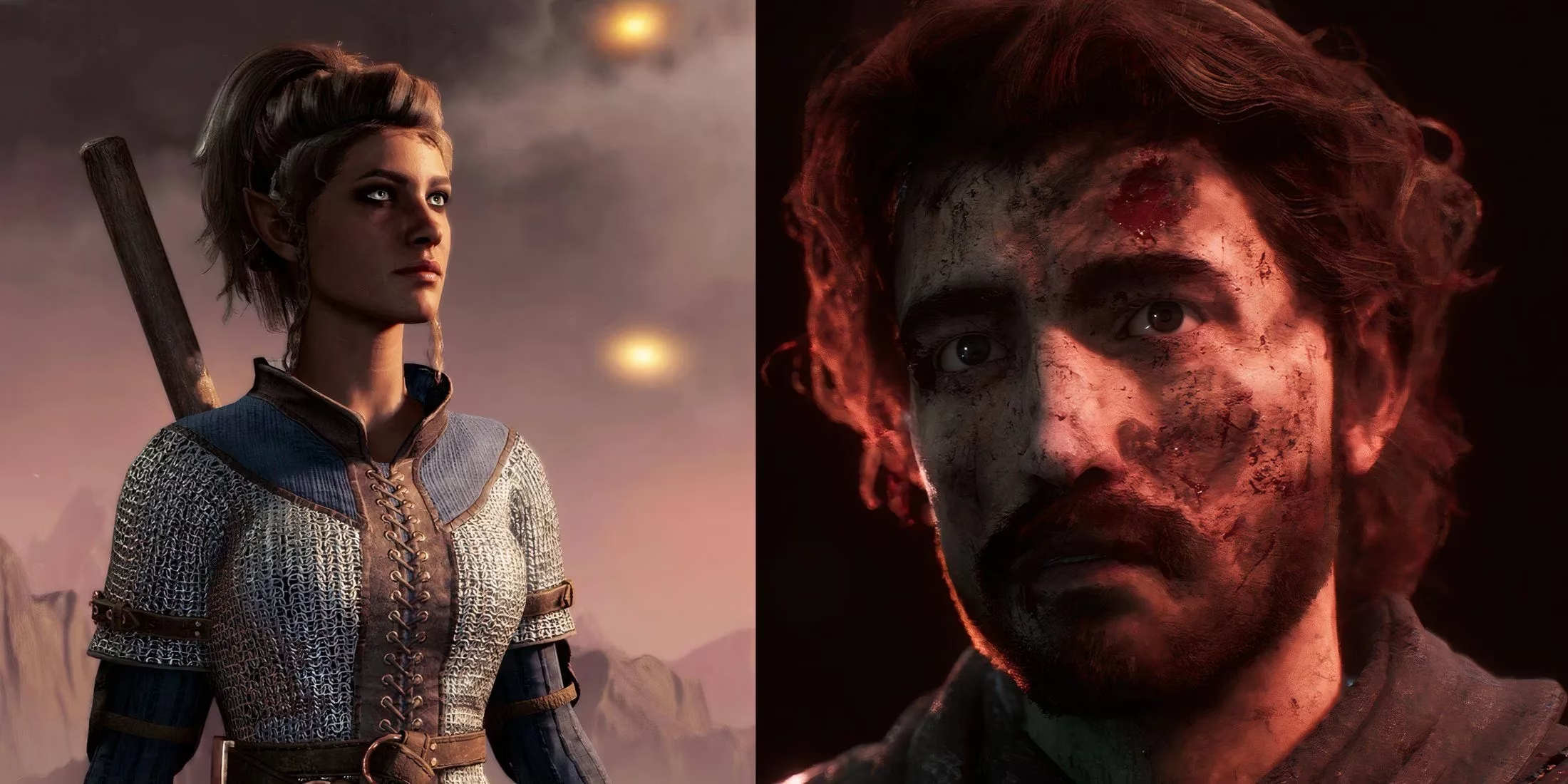
The Eternal Tension: Art vs. The Bottom Line 💸
Of course, the kitchen isn't always a serene place. Gaider honestly acknowledges the elephant in the room—the publisher, forever under the gun with financial pressures. In an age where development costs are sky-high and risks loom large, imposing strict deadlines is often seen as a necessary evil. "They’re constantly under financial pressure," he notes, highlighting the high-stakes poker game of modern game launches. A rushed game can be a recipe for disaster, a launch that falls flat and leaves a bitter aftertaste for years. The tension between artistic gestation and commercial expectation is the industry's great drama.
Yet, the triumphs of BG3 and Expedition 33 offer a counter-narrative. They showcase that betting on quality and depth can, ironically, be the soundest financial strategy. It's a go big or go home gamble that paid off spectacularly, proving that a deeply satisfying core experience has its own gravity, pulling in players from far beyond its intended orbit.
Building for the Devoted, Welcoming the World 🌍
Here lies the second secret ingredient in Gaider's analysis: authentic focus. He posits that both games succeeded because they were "designed for one core audience instead of trying to appeal to everyone." They were unapologetic love letters, written in the specific language of CRPG and JRPG fans. They didn't water down their mechanics or simplify their stories for mass consumption.
| Game | Core Genre Focus | Result |
|---|---|---|
| Baldur's Gate 3 (2024) | Complex CRPG / D&D Simulation | Engaged a massive, sustained player base post-launch. |
| Clair Obscur: Expedition 33 (2025) | Dark, Narrative-Driven JRPG | Exploded in popularity, defying "niche" expectations. |
But the beautiful paradox, as Gaider puts it, is that "it's so strong that it ends up growing that audience." A perfectly executed vision possesses a magnetic charm. The intricate rules of BG3 became a thrilling puzzle for newcomers. The melancholic beauty and strategic combat of Expedition 33 captivated players who never thought they'd enjoy a turn-based JRPG. By not chasing everyone, they ended up captivating almost everyone. Talk about a plot twist!
The Legacy in 2026: A Lasting Banquet 🍷
As we navigate 2026, the influence of these patient giants is palpable. Baldur's Gate 3 continues to host a vibrant community, its world ever-expanding. Meanwhile, Clair Obscur: Expedition 33 has solidified its place as a modern classic, its popularity not just a flash in the pan but a steadily burning flame. They stand as twin pillars, testaments to a philosophy that feels almost rebellious in a fast-paced world.
The lesson for players and creators alike is clear, and it's one that Gaider elegantly frames:
-
For Developers & Publishers: Have the courage to nurture a vision. The pressure is real, but the reward for a polished, heartfelt product is a legacy—and often, monumental success.
-
For Players: The best experiences are worth the wait. They are the ones that stay with you, the stories you recount and the worlds you revisit.
In the end, it’s about crafting something with soul, something that simmers until every flavor is perfect. Baldur's Gate 3 and Clair Obscur: Expedition 33 didn't just get served; they were a full-course meal prepared with care. And as any gourmand will tell you, that's always worth the wait. Here's to the next love letter, patiently waiting in the oven.