The Unfulfilled Dream: Merging GTA's Urban Realism with Baldur's Gate 3's RPG Depth
The compelling fusion of immersive RPG mechanics and a vibrant, realistic open world remains the holy grail for modern gamers, yet this powerful synthesis of deep role-playing freedom and authentic urban sandbox experience remains tantalizingly elusive.
The modern gamer's soul is a strange, often conflicted place. On one hand, there exists a deep, almost primal craving for the intricate, choice-driven narratives and character-building complexity that defines a masterpiece like Baldur's Gate 3. It's the desire to inhabit a role completely, to see the digital world bend and shift based on a carefully chosen word or a meticulously planned skill check. Yet, simultaneously, there's an equally powerful, visceral pull toward the sun-soaked, lived-in authenticity of sprawling urban playgrounds like those promised in Grand Theft Auto 6—the simple, profound joy of feeling like you're just existing in a vibrant, chaotic, and believable city. These two desires currently live in separate gaming universes, and the longing for their fusion feels more acute than ever as we look at the landscape of 2026.
It turns out that the 'R' in 'RPG' could, and perhaps should, stand for 'Real-World.' The gaming industry has historically treated these two genres—immersive sim/CRPG and open-world crime sandbox—as distinct species, rarely allowing them to interbreed. When we seek the satisfying 'crunch' of deep role-playing mechanics within a contemporary, realistic setting, the options are surprisingly sparse. Titles like Cyberpunk 2077 have come close, offering a dense cityscape, but they often fall short of delivering the pure, unadulterated role-playing freedom found in Baldur's Gate 3. Character creation remains limited to cosmetic and stat-based tweaks of a predefined protagonist, rather than building a unique persona from the ground up. Conversely, while Rockstar's iconic series has perfected the art of making a city feel alive with traffic, radio stations, and ambient chaos, it has never truly committed to making the player feel like a true RPG character within it. Non-player characters are often as reactive as storefront mannequins, and the systemic depth that would allow for genuine criminal role-play—planning, social manipulation, consequence—remains largely an afterthought. The city is a beautiful, static diorama; you are a tourist with a gun, not a citizen shaping your destiny.
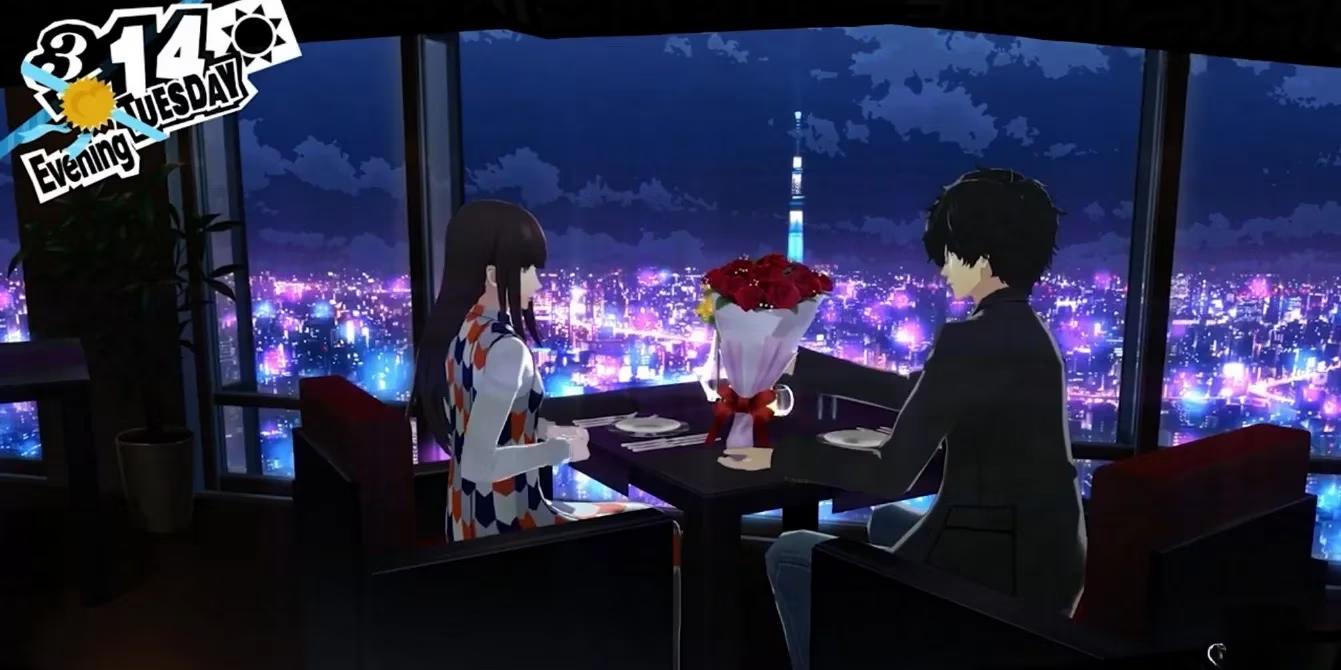
Where, then, are the RPGs that embrace our present in all its big, beautiful, and grimy glory? The list is short and treasured. Classics like EarthBound were beloved precisely for their quirky take on modern America. South Park: The Stick of Truth brilliantly translated a real(ish) town into an interactive RPG playground. The Persona series masterfully blends daily life in Tokyo with supernatural dungeons, and the Fallout games explore post-apocalyptic versions of real American cities. Yet, none capture the specific, sun-drenched, crime-tinged vibe of a GTA title—the feeling of Vice City's pastel hues or San Andreas's diverse landscapes. These games make you feel the heat of the pavement and the salt of the ocean air, but they stop short of letting you define the soul of the person experiencing it. Playing them can feel like watching an incredibly detailed documentary through a pane of unbreakable glass; you can observe the ecosystem, but you cannot alter its fundamental nature.
The potential of a true hybrid is staggering. Imagine a game that combined GTA's meticulously crafted, reactive urban environment with Baldur's Gate 3's profound narrative agency and character customization. This would not be a simple mashup, but an entirely new genre—a 'Urban Character Simulator.'
-
Character & Narrative: You wouldn't just be 'a criminal.' You could be a charismatic grifter who uses high Persuasion and Deception checks to talk your way into secure buildings, a tech-savvy hacker who manipulates the city's infrastructure (traffic lights, security systems, bank vaults) from a van, or a brute-force enforcer whose Intimidation opens doors that locks cannot. Your background—corporate dropout, disgraced cop, aspiring musician—would open unique dialogue trees and quest opportunities with different factions, from street gangs to corrupt city officials.
-
Gameplay Systems: The heist planning from GTA V would evolve from a pre-scripted mission into a genuine, systemic playground. Scouting a location would involve skill checks (Perception to spot hidden cameras, Intelligence to analyze blueprints). Assembling a crew would be like forming an adventuring party, balancing their unique skills and personalities, which could clash during the job itself. Combat, when it occurs, could offer a choice: the fluid, real-time chaos GTA is known for, or a tactical, pause-and-play mode that feels like orchestrating a criminal operation with the precision of a D&D battlemap.
-
The Living City: The city itself would become your character sheet. Building relationships with local shopkeepers, bartenders, or informants could unlock new services, rumors, or safe houses. Your reputation would precede you, affecting how NPCs react—crossing a powerful gang might mean their members actively hunt you in certain districts, while aiding a community could make it a safer haven. The city's rhythm—day/night cycles, weather, traffic patterns—wouldn't just be ambiance; they would be tactical considerations for your plans.
Envision the scenarios: using a high Charisma stat to convince a nightclub bouncer you're on the list, then picking the pocket of a mob boss during a cinematic dialogue cutscene. Or, spending a sunny afternoon customizing your lowrider's hydraulics (a crafting mini-game akin to alchemy), only to later use that same car as mobile cover in a turn-based shootout with rival drug dealers on a Venice Beach boardwalk—a confrontation that plays out with the strategic depth of a chess game, each action point spent as carefully as a precious resource. The city's open world would be less a playground for mayhem and more a living, breathing character creator, where every interaction writes another line in your biography.
As of 2026, this dream game remains just that—a dream. Developers like Ryu Ga Gotoku Studio have bravely pivoted the Yakuza/Like a Dragon series toward turn-based RPG mechanics, proving that deep stat-based combat can thrive in a modern urban setting. Yet, even these excellent games are ultimately guided narratives set in a contained district, not the vast, systemic, player-driven sandbox we imagine. The industry seems hesitant to make the monumental investment required to build two incredibly deep games—a top-tier RPG and a top-tier living-city simulator—inside a single package.
The call is clear. Some visionary studio needs to bridge this chasm. We need a game that lets us finally bring peace to the two wolves within. Let one wolf drive a stolen convertible along a digital coastal highway at sunset, the radio blasting. Let the other wolf, in that same moment, open a skill menu to allocate points into 'Driving' and 'Cool,' deciding whether this character would flip off the cops now tailing them or attempt a slick, dialogue-based negotiation to talk their way out of a ticket. The potential isn't just for a great game; it's for a new way to experience and role-play within a world that mirrors our own, with all the endless possibility that true freedom affords. The player base is waiting, controllers in hand, for a world where they can truly live a double life.