The Motion Capture Debate: Why Performance Awards Need a New Category
The 2026 Game Awards spotlighted Charlie Cox's nomination for Best Performance, igniting a vital debate on motion capture recognition in gaming.
As I reflect on the 2026 awards season, the nomination of Charlie Cox for Best Performance at The Game Awards remains a fascinating point of discussion. It's not that his portrayal of Gustave in Clair Obscur: Expedition 33 wasn't compelling—it was a masterclass in subtlety and gravitas. The contention stems from the fact that his character's arc concludes dramatically at the end of Chapter 1, meaning Cox's direct involvement constituted only a portion of the game's runtime. Cox himself has been remarkably candid, noting that his recording sessions lasted mere hours and publicly deflecting praise toward the motion-capture artist who physically brought Gustave to life, Maxence Cazorla. This honest acknowledgment has sparked a vital industry-wide conversation about who truly performs in our modern video games.
The debate found a powerful voice in Aliona Baranova, the performance director behind the legendary characters of Baldur's Gate 3. Seeing the discourse around Cox and Cazorla, Baranova took to social media to propose a simple yet revolutionary idea: awards shows need a dedicated motion capture category. "yup, I think we should have a motion capture category at awards shows," she stated plainly. Her perspective isn't just theoretical; it's born from years in the trenches, directing performances where an actor's voice and a performer's physicality are inseparable strands of the same character. This call for recognition goes beyond just giving credit where it's due; it's about reshaping how we appreciate the art form.
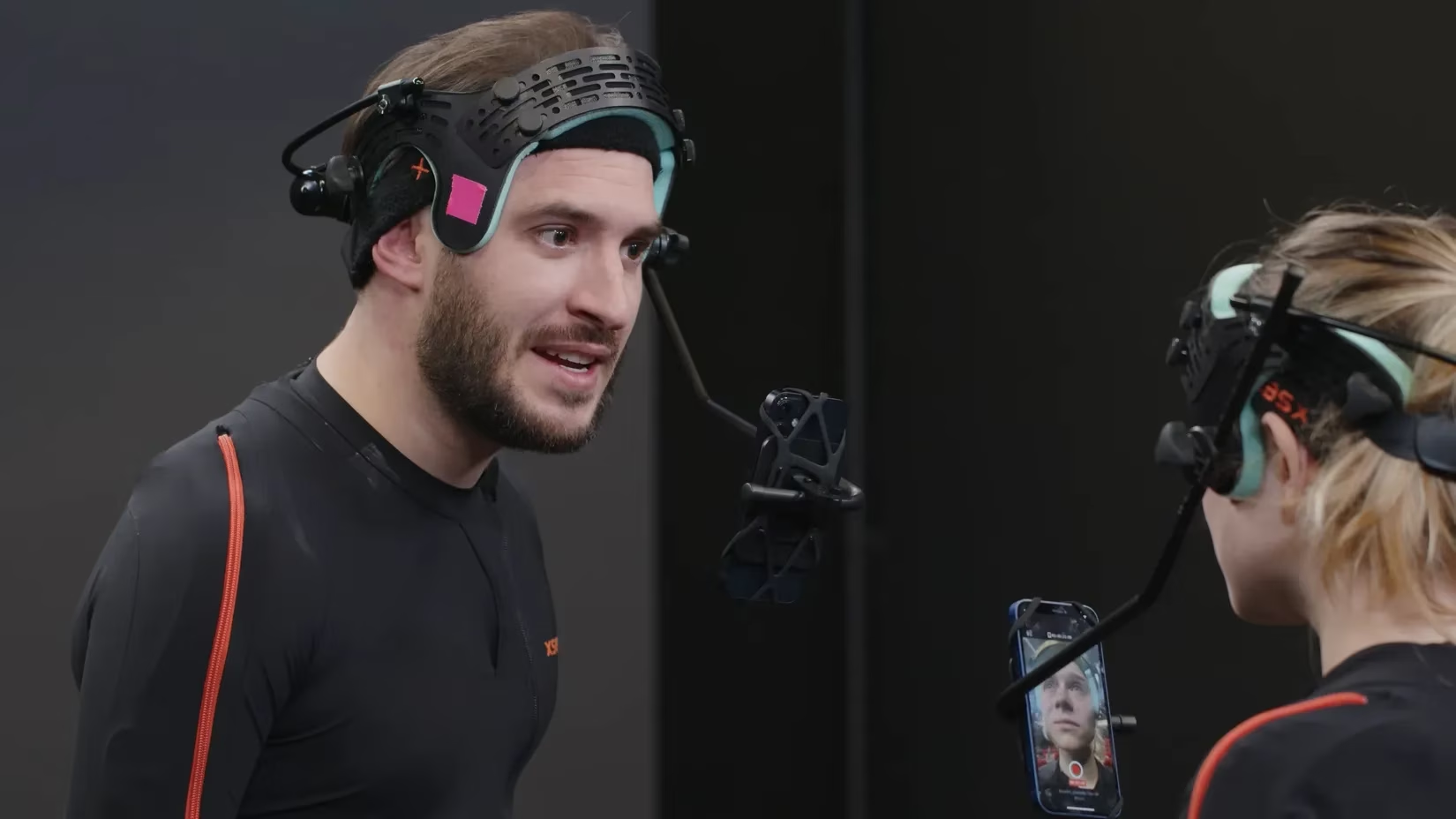
Why is this so important now? Baranova argues that a formal award category would incentivize studios to pull back the curtain. She pointed out that it's rare to see the raw, unedited long takes from the motion-capture volume. Studios like Sandfall Interactive, which shared Cazorla's work on Clair Obscur, are exceptions. "An awards category could encourage more studios to release behind-the-scenes long takes of the mocap... It’s rare, but if more bts footage was shared, people would get to see the amazing performances ppl put in," she explained. Imagine a world where audiences regularly witness the incredible physical and emotional commitment of mocap artists—the sweat, the choreography, the raw embodiment of a character before a single polygon is modeled. It would fundamentally alter public perception, transforming these performers from invisible technicians to celebrated artists in their own right.
This conversation sits at the heart of a broader evolution in game development. The line between voice acting and physical performance has blurred into oblivion. A modern AAA character is a synthesis:
-
Vocal Nuance from the voice actor.
-
Physical Embodiment from the motion-capture performer.
-
Creative Direction from performance directors like Baranova.
-
Technical Wizardry from animators and programmers.
To award only one link in that chain feels increasingly anachronistic. It's like giving a Best Picture Oscar solely to the lead actor. The current 'Best Performance' category struggles to contain this multifaceted reality, often defaulting to the most recognizable name—usually the voice actor—while the physical performer's contribution remains in the shadows.
As someone who follows this industry closely, I find Baranova's advocacy incredibly refreshing. The games community is often quick to celebrate actors who cross over from film and television, and rightly so. Yet, the artists who have dedicated their careers to the unique craft of physical performance for games—the ones who spend days in skin-tight suits, acting out combat, heartbreak, and death in an empty gray room—rarely receive that same spotlight. Establishing a motion capture category wouldn't diminish the achievements of voice actors; instead, it would expand the awards' vocabulary to properly honor the collaborative nature of the medium.
This year's Game Awards will be particularly poignant for Baranova, not just professionally but personally. Her partner, Jennifer English, is nominated in that same Best Performance category for her role as Maelle. English, who won Best Leading Performance at The Golden Joysticks, is a powerhouse talent. Her potential victory would be a wonderful moment, yet it would also highlight the very asymmetry Baranova is addressing. Celebrating English's vocal performance while Cazorla's physical work on Gustave goes formally unrecognized underscores the need for systemic change.
The path forward seems clear. Award bodies like The Game Awards have a responsibility to evolve alongside the art they celebrate. Introducing a 'Best Motion Capture Performance' category would be a landmark step. It would validate an essential discipline, inspire new talent to enter the field, and give fans a deeper appreciation for the magic behind their favorite characters. It's time for the awards shows to catch up to the reality of how games are made. The performance is not just in the voice; it's in every swing of a sword, every hesitant step, and every silent glance that a mocap artist breathes into existence. Recognizing that fully is the next great challenge—and opportunity—for our industry.