The Monk's Rebirth: From D&D's Underdog to Baldur's Gate 3's Martial Powerhouse
Discover how the Monk class in Baldur's Gate 3 and Dungeons & Dragons transforms from overlooked to extraordinary, blending discipline with digital mastery.
Have you ever wondered what it feels like to find your voice in a world that once overlooked you? I have, and so has the humble Monk, a class whose journey from the pen-and-paper realms of Dungeons & Dragons to the digital landscapes of Baldur's Gate 3 is nothing short of a spiritual awakening. In the quiet corners of taverns and the hallowed halls of monasteries, a tale of transformation unfolds—one where perceived weakness is reforged into undeniable strength. Is it not poetic that the class built on discipline and inner focus required a new medium to truly shine? Baldur's Gate 3, that magnificent digital canvas, did not just translate the Monk; it listened to its silent prayers and answered with a symphony of fists and ki.
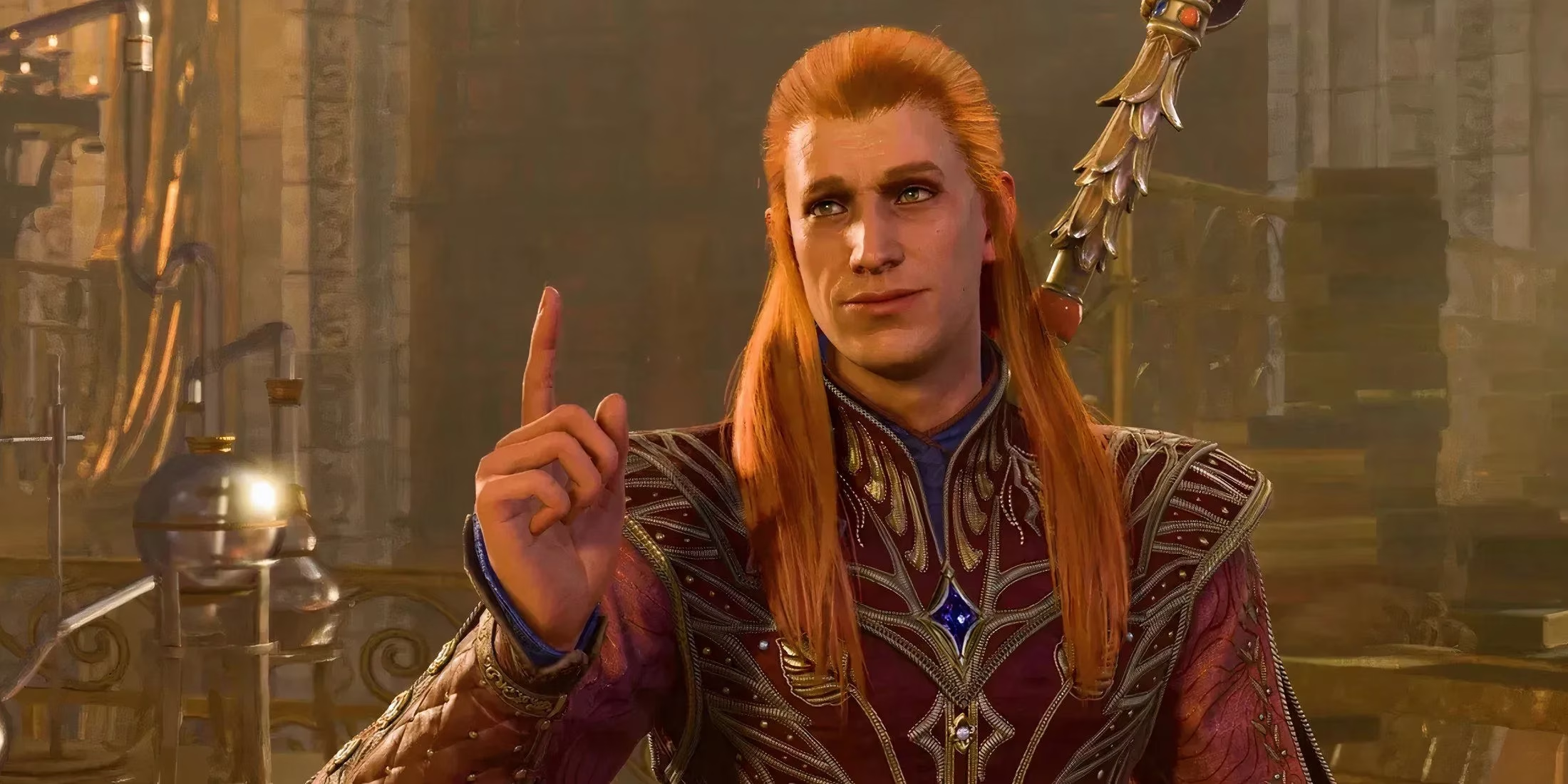
The Paper Legacy: A Monk's Quiet Struggle
In the original tapestry of Dungeons & Dragons, I often felt like a whisper in a thunderstorm. As one of the twelve original classes from the Player's Handbook, my path was purely martial—a path walked with bare feet and open hands. Yet, in a world where wizards unraveled reality and clerics channeled divine wrath, what place was there for one who sought power from within? The martial family—Barbarian, Rogue, Fighter, and myself—often stood in the long shadow cast by spellcasters. Among my kin, my choice felt the most ascetic: fighting unarmed meant fewer weapons to wield, lighter armor to don. This wasn't a flaw of spirit, but a design of circumstance. A Dungeon Master's heart had to be especially kind, weaving homebrew items or bending rules, just to let me keep pace with my companions on our grand adventures. My strength lay not in raw power, but in the story—the unique, contemplative backstory a player could craft, the roleplaying potential of a soul seeking enlightenment amidst chaos. But was potential enough when the dice fell and battle called?
The Digital Alchemy: How Baldur's Gate 3 Forged a New Path
Then came the gateway—Baldur's Gate 3. Its developers performed not mere translation, but alchemy. They saw the core of the Monk not as a list of limitations, but as a promise of kinetic artistry. The changes, though systematic, felt deeply personal to me:
✨ The Rhythm of Rest: The adaptation of short rests meant my ki—the wellspring of my power—replenished more frequently. No longer was I a spent force after a single flurry; I could flow from encounter to encounter, a sustained river of motion.
✨ A Treasure Trove for the Ascetic: Suddenly, the world was filled with items that spoke my language. Quarterstaves that hummed with energy, humble clothing that fortified my unarmored defense—these were not afterthoughts, but treasures placed with intention. They supported my unique skills, granting magical effects to my unarmed strikes, turning my very body into a channel for the Weave.
✨ The Power Spike Realized: At Level 5, the gift of Extra Attack arrived. What was once a theoretical power spike in handbooks became a visceral, turn-by-turn reality. My damage output didn't just increase; it exploded. I transformed from a supportive skirmisher into a damage-dealing powerhouse, my flurry of blows echoing with the same decisive impact as a Barbarian's greataxe or a Fighter's action surge. These weren't minor tweaks; they were the keys to my prison cell.
Standing Among Legends: Legitimacy Forged in Story
Perhaps the most profound change was not in the mechanics, but in the narrative respect. Baldur's Gate 3 didn't just make me viable; it made me venerable. Look at the figures who walk its story:
-
Orpheus, a being of immense psionic power, whose very presence shakes the heavens.
-
The high-ranking Githyanki warriors, disciplinarians of the Astral Plane.
These are Monks. The game's world looks at my class and sees not an underdog, but a legitimate path to power. It established my place in the lore, weaving the Monk's discipline into the fabric of its cosmic conflict. When I create my character, I am no longer choosing a niche roleplay option; I am stepping into the shoes of a archetype that the world itself fears and respects.
Choosing Your Path: The Four Pillars of the Monk
As a player embracing this reborn class in 2026, I am presented with four distinct subclasses, each a different philosophy of combat:
| Subclass | Playstyle & Strength | Vibe & Roleplay |
|---|---|---|
| Way of the Open Hand 👐 | The uncontested peak. Masters of control and raw, focused damage. | The quintessential disciplined martial artist. |
| Way of the Four Elements 🔥🌊💨🌍 | A powerful spell-weaver, blending ki with elemental forces. | The avatar-like channeler of primordial power. |
| Way of the Shadow 👤 | The stealthy infiltrator, perfect for tactical strikes and mobility. | The silent watcher, the unseen guardian. |
| Way of the Drunken Master 🍺 | A clever, evasive fighter using the game's abundant alcohol mechanics. | The hilarious and unpredictable trickster (though often lagging in pure power). |
The Open Hand offers sheer mastery, the Four Elements brings magical versatility, the Shadow provides tactical cunning, and the Drunken Master... well, it offers a uniquely Baldur's Gate 3 experience, turning tavern brawls into an art form, even if it doesn't always keep up mathematically.
In the end, my journey from the tabletop to the screen is a testament to the magic of adaptation. Baldur's Gate 3 saw the soul of the Monk—the fantasy of perfect self-mastery, the body as the ultimate weapon—and built a system that let it soar. It asked: "What if the quiet one was also the most dangerous one?" and then spent a hundred hours answering that question with every ki-powered strike. I am no longer the class you play for the backstory alone. I am the class you play to become the storm.