The Fancy Footwork Achievement: A Testament to Baldur's Gate 3's Philosophy of Freedom
In the immersive world of Baldur's Gate 3, the Fancy Footwork achievement brilliantly redefines player skill, transforming a traditional stealth challenge into an ingenious invitation for creative problem-solving.
In the luminous, ever-evolving landscape of role-playing games, achievements are often considered final, immutable verdicts on a player's skill—marble tablets etched with the names of those who endured the harshest trials. As someone who has walked the Sword Coast countless times since the game's release, I've come to see them differently, especially in Baldur's Gate 3. Here, in this world sculpted from possibility, an achievement is not a test of endurance but an invitation to dream, to weave your own path through the chaos. The Fancy Footwork achievement stands as a shimmering, debated emblem of this very principle. It is a riddle wrapped in a challenge, a statement that in this realm, the truest difficulty is not in following the path laid before you, but in realizing you can build your own.

To the uninitiated, the objective sounds like a classic test of precision: navigate Gortash's audience hall without triggering a single, lethal mechanism. The hall itself is a masterpiece of hostile architecture, a space that hums with malicious intent even when the towering Steel Watch sentinels stand silent. It is a gauntlet designed to punish the slightest misstep, where pressure plates and hidden triggers can unleash a storm of concussive force and searing flame. In 2026, with the game's systems fully explored, this still presents itself as the ultimate stealth challenge, demanding:
-
Meticulous observation of every tile and shadow.
-
Perfect timing and spatial awareness.
-
A deep understanding of the game's sneak and movement mechanics.
For a lover of traditional, tense dungeon crawls, this is the pinnacle. It feels like the game is asking for a flawless performance, a ballet of avoidance where one wrong move spells a fiery end. The statistic that only a fraction of players have unlocked it seems to confirm its status as a grueling trial of patience and skill.
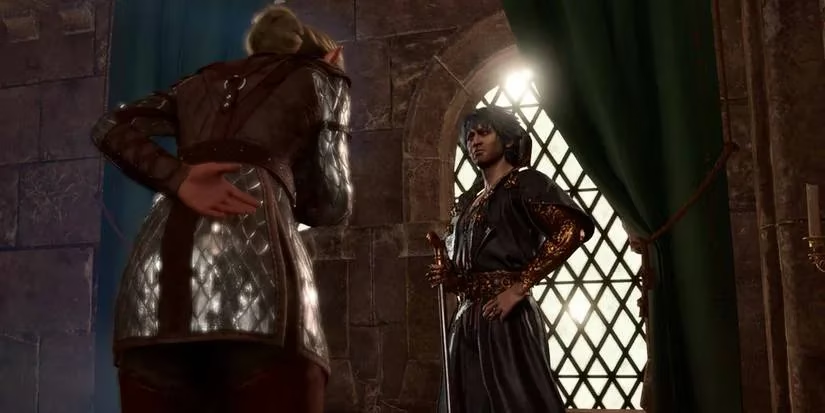
Yet, to assume Baldur's Gate 3 demands a single solution is to misunderstand its very soul. The game does not just allow creativity; it demands it, celebrates it, and often rewards the most absurd lateral thinking. The revelation around Fancy Footwork is a beautiful subversion. The hall is only a deathtrap if you allow it to become one. If you confront the Archduke Gortash before his machinations are fully set, the achievement will still unlock, having never danced the deadly dance at all. This isn't a loophole; it's a feature. The game's systems are a toolkit, and the achievement is a prompt, not a prescription.
This approach reframes the entire endeavor. The challenge transforms from 'How do I avoid these traps?' to the far more profound question: 'How do I approach this problem?' The game presents you with a fortified chamber and a powerful foe. Do you:
-
Engage in a tense game of cat and mouse with the environment?
-
Use dialogue, deception, or alliance to manipulate the situation?
-
Launch a preemptive, overwhelming assault to negate the threat entirely?

Some may cry that such methods cheapen the accomplishment. From my perspective, nestled in my own journey through Faerûn, they do the opposite. They elevate it. In a landscape crowded with games that enforce rigid mastery, Baldur's Gate 3 asks for intelligent engagement with its world. Difficulty is not a meter of imposed suffering but a measure of how adeptly you can adapt, manipulate, and conquer the tools you've been given. This philosophy permeates every corner of the experience:
-
A deadly combat can be resolved with silver-tongued persuasion or clever bribery.
-
A corridor of fire traps can be neutralized by summoning a water elemental or tossing a created water barrel.
-
A mighty boss can be defeated in an epic, spell-slinging duel or given a swift, ignoble end with a well-placed shove off a cliff.
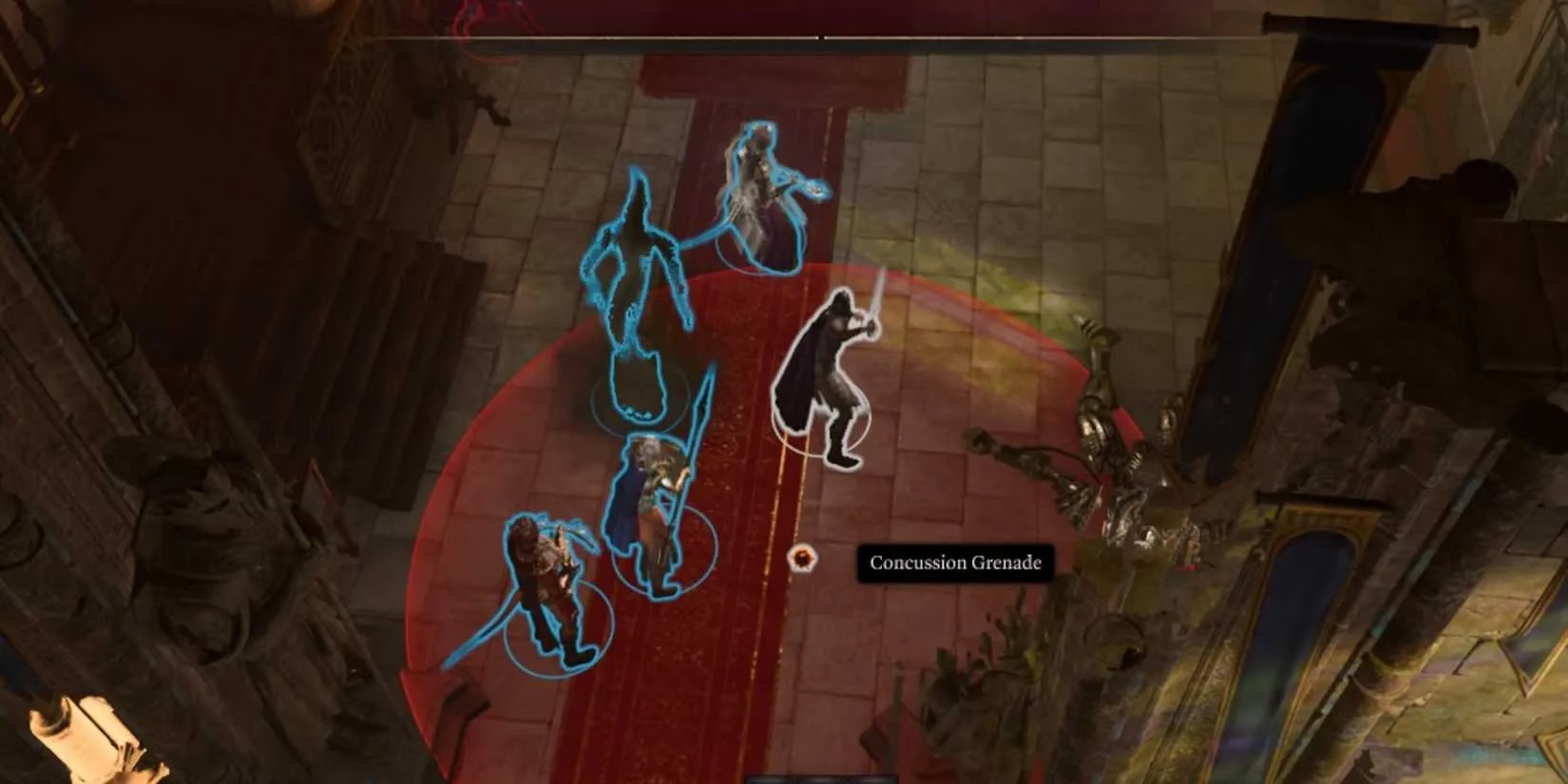
Fancy Footwork, therefore, becomes a brilliant case study. It demonstrates that Larian Studios designs achievements not as fixed targets but as exploratory beacons. They encourage you to poke at the boundaries of the simulation, to see what happens when you apply spells in unintended ways, approach encounters from unorthodox angles, or simply decide that the prescribed challenge is beneath you. It's a celebration of player agency in its purest form. The game doesn't care how you pacify the hall; it only cares that you did, and it rewards the cleverness of your method, whether that method involved silent footsteps or a thunderous, trap-skipping assault.

As I reflect on my journeys in 2026, with new players discovering the game every day, Fancy Footwork remains a poignant lesson. It reminds me that Baldur's Gate 3 is less concerned with telling you who to be and more invested in allowing you to discover who you are within its world. Are you the meticulous ghost, the silver-tongued diplomat, or the pragmatic strategist who eliminates problems before they fully form? The achievement, like the game itself, has no preference. It simply acknowledges your chosen path with the same chime of success. In the end, Fancy Footwork isn't really about traps or Gortash. It's a mirror, reflecting back the boundless, creative spirit that this masterpiece of an RPG seeks to nurture in every one of us who walks its paths.
In the ever-expanding universe of gaming, the journey through Baldur's Gate 3 exemplifies a unique blend of creativity and strategy that resonates with players seeking freedom in their gameplay experience. As we continue to explore new realms and challenges, finding resources and communities that enhance our adventures can be invaluable. For those who are keen on discovering tips, tricks, and insights into maximizing their RPG experience, Lootbar offers a multitude of perspectives that can enrich your gameplay strategies.
Whether you're a seasoned adventurer in Faerûn or a newcomer eager to learn the ropes, engaging with communities and platforms like Lootbar can provide the guidance and inspiration needed to master the art of player agency and creativity. By connecting with fellow enthusiasts and experts, you can continue to explore the vast possibilities that games like Baldur's Gate 3 offer, ensuring your journey is both rewarding and fulfilling.