The Enigmatic Journey of Zlorb: Baldur's Gate 3's Most Mysterious Creature
Baldur's Gate 3's Strange Ox captivates players with its mysterious transformation and hidden narrative depth, evolving from enigma to ally.
In the sprawling, character-rich world of Baldur's Gate 3, few beings have sparked as much lingering curiosity as the Strange Ox. By 2026, countless adventurers have crossed its path, yet its true purpose remains an enigma wrapped in a riddle, hidden beneath a placid bovine exterior. This creature is not merely a background detail but a subtle, woven thread in the game's vast narrative tapestry, a puzzle that many players complete without ever fully understanding the picture. Its journey from a suspicious farm animal to a potential ally against the Nether Brain is a testament to the game's hidden depth, where even the most unassuming encounter can unfold into a saga of deception, divine intrigue, and oozing ambition.
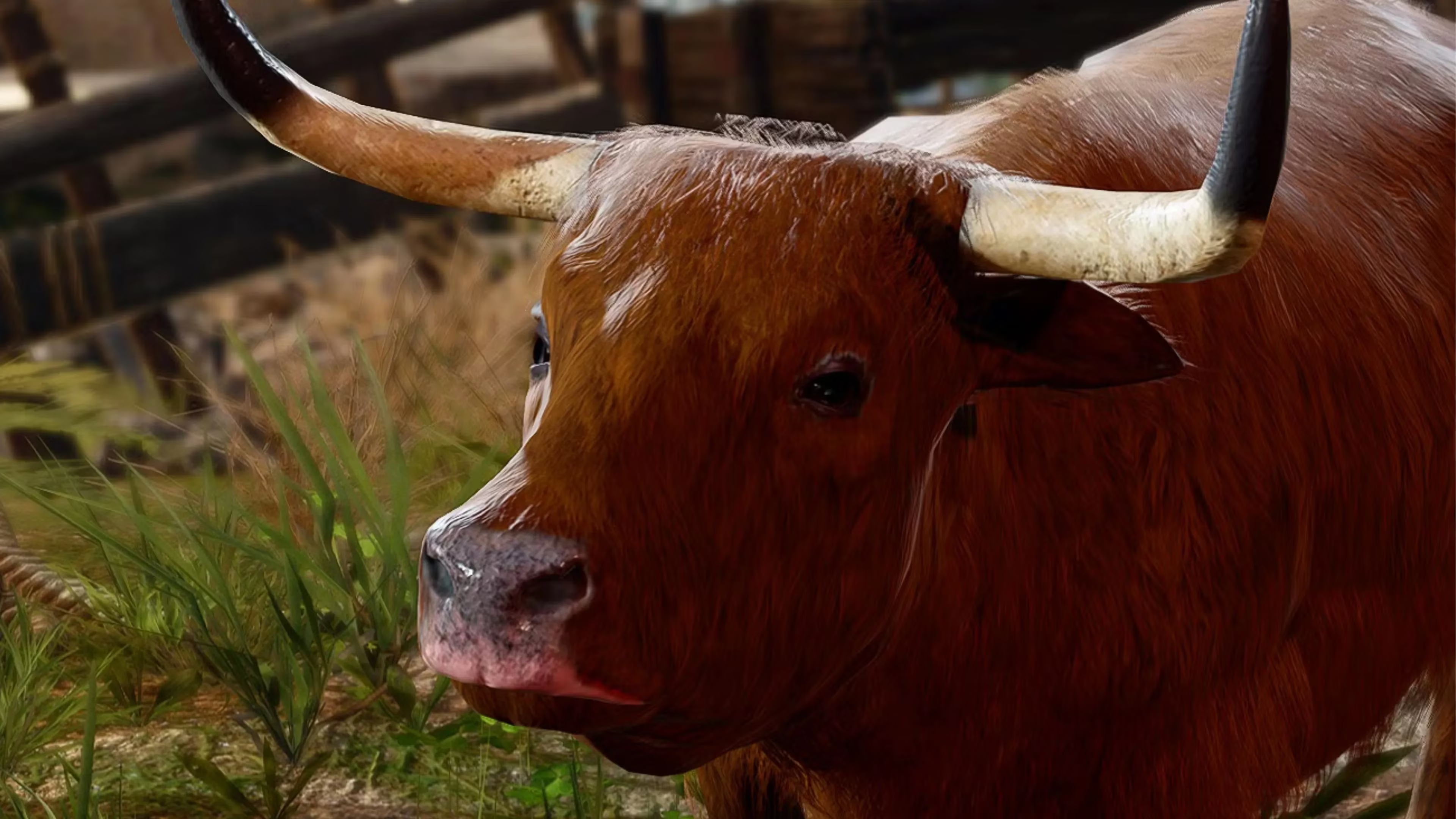
The story begins, for most, in the relative safety of the Emerald Grove. Amidst druids and tieflings, a single ox stands out to those attuned to the arcane. It feels wrong, like a perfect melody played on an instrument slightly out of tune. A successful perception check or a bit of magical insight reveals a dissonance beneath its hide. With careful persuasion, this "animal" can be coaxed into a brief, unsettling telepathic conversation, its thoughts foreign and its motives opaque. For many parties, this is where the encounter ends—a bizarre footnote soon forgotten in the chaos of goblin camps and mind flayer parasites. Yet, like a seed planted in fertile soil, this oddity was destined to grow into something far more complex.
The creature's next appearance is a masterclass in atmospheric storytelling. In the shadow-cursed lands of Act 2, at the Last Light Inn, the Strange Ox reappears. Here, it communicates not with words, but with violent psychic imagery: flashes of corpses and echoes of screams that assault the player's mind. This is the creature's warning, a psychic barbed wire fence. Players who push past this horrific mental broadcast and continue the dialogue trigger a startling transformation. The ox's form melts away like a wax figure held too close to a flame, revealing its true nature: a phasm ooze known as Zlorb. This gelatinous entity, a deep-cut reference to the expanded 3.5 edition Dungeons & Dragons rules, attacks the party, its motivations as murky as its physical form.
However, violence is not the only path. Astute players who offer the creature reassurance—a promise not to expose its secret—unlock its continuing storyline. This decision proves crucial. Later, in Rivington during Act 3, Zlorb seeks out the party once more. It has a singular, peculiar request: to be smuggled into Baldur's Gate's heavily guarded Lower City. Agreeing to this turns the amorphous ooze into one of the inventory's most bizarre items—a Strange Apple. Zlorb's entire being is contained within this unassuming fruit, a secret passenger on the hero's journey. The quest auto-completes upon entering the city, and Zlorb departs, leaving behind only a slightly damp note praising Cyric, the Faerunian god of lies and strife, and a vague promise of a future favor.
This divine allegiance is the key to understanding Zlorb's enigmatic heart. Cyric is not a deity associated with altruism or straightforward deals. Worshipping Cyric is like making a bargain with a sentient, ever-shifting maze—the path is never clear, and the exit might not be where you hoped. Zlorb's veneration of this god strongly suggests its goals are far from pure-hearted. Perhaps it sought refuge, perhaps it pursued its own inscrutable agenda, but its association with the Lord of Lies casts a long, doubtful shadow over its professed desire for a simple life as a "red-backed river ox."
The payoff for this strange companionship comes during the epic final confrontation with the Nether Brain. Zlorb honors its promise, appearing as a summonable ally. It manifests not as a simple ooze, but as a massive, empowered ochre jelly with a unique ability to shapeshift mid-combat into other formidable creatures, such as a minotaur or a shadow mastiff. In the chaos of the final battle, Zlorb becomes a wildcard, a protean asset whose form is as unpredictable as its motives. Its presence is a reward for curiosity and discretion, a powerful, if unsettling, friend made from the most unlikely of beginnings.
| Zlorb's Journey | Location | Key Interaction | Outcome |
|---|---|---|---|
| First Encounter | Emerald Grove (Act 1) | Arcane detection & conversation | Reveals strangeness; can be ignored. |
| Second Encounter | Last Light Inn (Act 2) | Telepathic horror show & confrontation | Can fight Zlorb (phasm ooze) or reassure it. |
| The Deal | Rivington (Act 3) | Smuggling request | Zlorb becomes a "Strange Apple" in inventory. |
| Conclusion & Reward | Lower City / Final Battle | Quest completion & alliance | Gains Cyric's note; becomes a summonable shapeshifter ally. |
Reflecting on Zlorb's arc, it stands as one of Baldur's Gate 3's most brilliantly hidden narratives. It is a subplot that operates like a sophisticated clockwork mechanism hidden behind a painted pastoral scene—only those who look closely and interact with its gears see the complex machinery at work. For players who followed its trail, Zlorb transforms from a background oddity into a memorable character with divine connections and potent battlefield utility. Its story is a perfect example of the game's design philosophy: rewarding exploration, dialogue, and a willingness to engage with the world's deepest, strangest secrets. In the end, Zlorb remains a mystery, a creature of lies serving a god of deception, yet for a brief moment during the fate of Faerûn, it stood—in whatever form it chose—as an ally.
In a world as richly detailed as Faerûn, the allure of hidden narratives like Zlorb’s is just the beginning of what players can uncover. For those who relish the thrill of discovery, delving into the game’s many secrets can be as rewarding as the epic battles themselves. Fans seeking to enhance their gaming experience with unique insights, guides, and community discussions will find a valuable resource in Lootbar. This platform provides an engaging hub for gamers eager to deepen their understanding and share their adventures.
Whether you're strategizing your next encounter or simply curious about Faerûn's vast lore, connecting with like-minded enthusiasts can enrich your journey. The dynamic community at Lootbar offers a space to explore these narratives further, ensuring that every player can find their path through the mysteries and wonders of Baldur's Gate 3.