Mass Effect 4: Why It Needs to Steal Baldur's Gate 3's Best Party Tricks
Mass Effect 4 must learn from Baldur's Gate 3's revolutionary choice-based storytelling and permanent consequences to deliver a truly dynamic, high-stakes RPG experience.
Alright, folks, let's have a real talk. As a lifelong RPG fan who's spent more hours in fictional galaxies than I care to admit, I've been watching the BioWare saga with bated breath. We're in 2026, and the entire gaming world knows BioWare is betting the farm on Mass Effect 4. The pressure? Astronomical. The legacy? Heavier than a Krogan in full battle armor. The original trilogy gave us those gut-wrenching, "oh-crap-did-I-just-do-that" moments where Wrex could bite the dust on Virmire or the entire Quarian fleet could become space dust. It was messy, it was emotional, and it was glorious. But let's be real—the RPG landscape has evolved. While we were busy scanning planets for minerals, Baldur's Gate 3 came along and basically said, "Hold my healing potion." It didn't just raise the bar for choice-based storytelling; it launched that bar into a different stratosphere. And for Mass Effect 4 to not just succeed but slay, it needs to take some serious notes from Larian's masterpiece. No more training wheels, Commander.
1. Goodbye, Plot Armor! Hello, Permanent Consequences 🚀
One of the most mind-blowing (and slightly terrifying) things about Baldur's Gate 3 is its ruthless commitment to consequence. Your companions aren't just loyal puppies following you around. Push them too far, and they'll peace out. Karlach might tell you to take a hike if you're a jerk. Lae'zel could decide you're the enemy based on how you handle her people's drama. Even Shadowheart's devotion hangs by a thread, tied to her faith and your actions. This isn't a game; it's a dynamic, breathing world that reacts to you.
Mass Effect has dabbled in this. Remember the Suicide Mission in ME2? A wrong move could mean saying a permanent goodbye to Mordin or Tali. But that was often a single, high-stakes moment. BG3 makes this tension the entire game. Mass Effect 4 needs to embrace this fully. Imagine recruiting a potential squadmate in the first act, only to lose them forever because of a choice you made three missions ago—before they even set foot on your ship. That's the kind of stakes that make your heart pound and your savescumming finger twitch. It makes every interaction matter.
2. Ditch the Paragon/Renegade Meter—It's Time for Nuance, Baby! 🤔
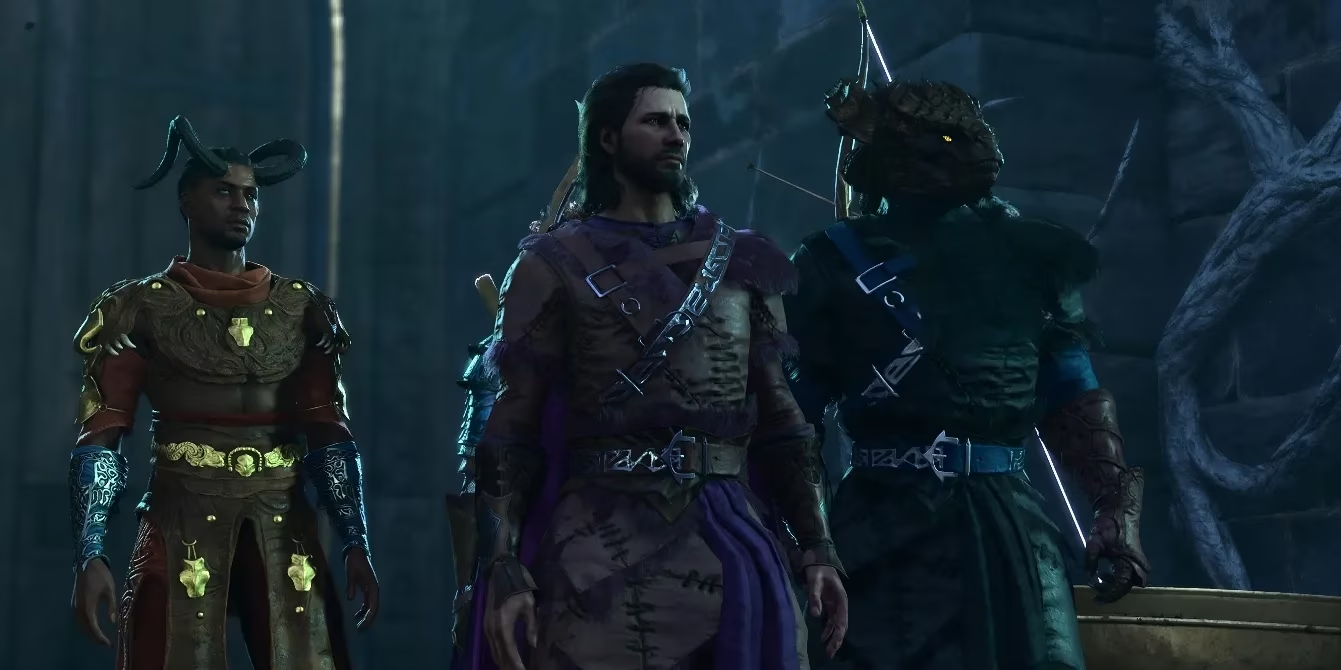
Let's address the big, blue-and-red elephant in the room: the binary morality system. Paragon good, Renegade bad. It was fun for a while, giving us clear-cut "Saint Shepard" or "Reaper-Lite Shepard" paths. But in 2026? That feels about as nuanced as a Volus headbutt. Baldur's Gate 3 threw that system out the airlock. Companions don't react to some abstract "good" or "evil" score. They react based on their own, deeply personal values, traumas, and goals.
| BG3 Companion | What They Love | What They Hate |
|---|---|---|
| Wyll | Heroic, self-sacrificing acts | Breaking oaths, unnecessary cruelty |
| Astarion | Cunning, self-preservation, chaos | Naive do-gooderism, being controlled |
| Lae'zel | Strength, decisive action, honor | Weakness, indecision, disobedience |
Imagine this in the Mass Effect universe. A pragmatic Salarian scientist might approve of a ruthless, efficient solution to a problem, while your idealistic Asari commando is utterly horrified. There should be no single "right" dialogue path that keeps everyone in your squad happy. This creates delicious moral ambiguity. Do you side with the pragmatic choice your Krogan tank agrees with, knowing it will alienate your principled Turian officer? That's real drama. That's character depth. Mass Effect 4's writing would be next-level if it forced us to make choices that fracture relationships organically, not because we didn't fill up a blue bar.
3. Let. Players. Fail. (Seriously, It's Okay!) 💀
This is perhaps the most crucial lesson. Baldur's Gate 3 has the cojones to let you fail—spectacularly and permanently. You didn't get to a companion in time? They're dead. Story moves on. You botched a persuasion check with a major NPC? Welp, that avenue is closed. Forever. The game doesn't wrap you in a safety blanket; it gives you a universe and says, "Deal with it."
The original Mass Effect trilogy had shades of this, but Mass Effect 4 needs to go all-in. Plot armor must be jettisoned out the nearest airlock. Not every character needs a heroic send-off or a neatly wrapped arc. Sometimes, in war (and in great RPGs), people die in messy, unfair ways. The series thrived on this high-stakes feeling in ME2, and it's time to recapture that magic. If there's no risk of losing someone truly important—be it a squadmate, an ally fleet, or an entire colony—then what's the point? The cost of victory should be palpable. The survivors should feel earned, their presence a testament to your skill (or luck!).
4. Dynamic Relationships, Not Checkbox Romances ❤️🔥
Mass Effect pioneered the squad-based space opera romance, and we love it for that. But BG3 showed us relationships can be so much more... complicated and fluid. They're not just a series of charm checks leading to a cutscene. They're built (or destroyed) through consistent action and aligned values over the entire journey.
Mass Effect 4 should make companion relationships a living, breathing system. Your standing with them should shift subtly (or not-so-subtly) with every major decision, not just during their dedicated "loyalty mission." They should argue with each other on the ship. They should challenge your orders if they fundamentally disagree. Maybe they even form alliances or rivalries independent of you. This creates a party that feels like a group of individuals with agency, not just a collection of tools for the player. It makes the Normandy (or whatever our new ship is) feel truly alive.
The Bottom Line: No More Safe Bets
Look, I love Mass Effect like I love my morning cup of Ryncol (which is to say, a lot, but it's probably bad for me). But for Mass Effect 4 to land in 2026 and beyond, it can't just be a nostalgic victory lap. It has to evolve. It has to be brave enough to learn from the new king of the RPG hill. Baldur's Gate 3 didn't just set a new standard; it gave us a blueprint for making player choice feel terrifyingly, wonderfully real.
BioWare needs to embrace the chaos. Give us companions we can truly lose. Give us moral dilemmas without a clear "good" answer. Give us a story where success is measured not in XP or credits, but in what—and who—we sacrificed to save the galaxy one more time. The weight of the legacy isn't just about living up to the past; it's about being bold enough to define the future. Make us feel like Specters again, not just tourists with really big guns. Let's go!