Epic RPGs That Hook You Harder the Longer You Play: A Gamer's Deep Dive
Discover the best RPGs that get better as you play, featuring immersive progression and rewarding gameplay that keeps you hooked for hours.
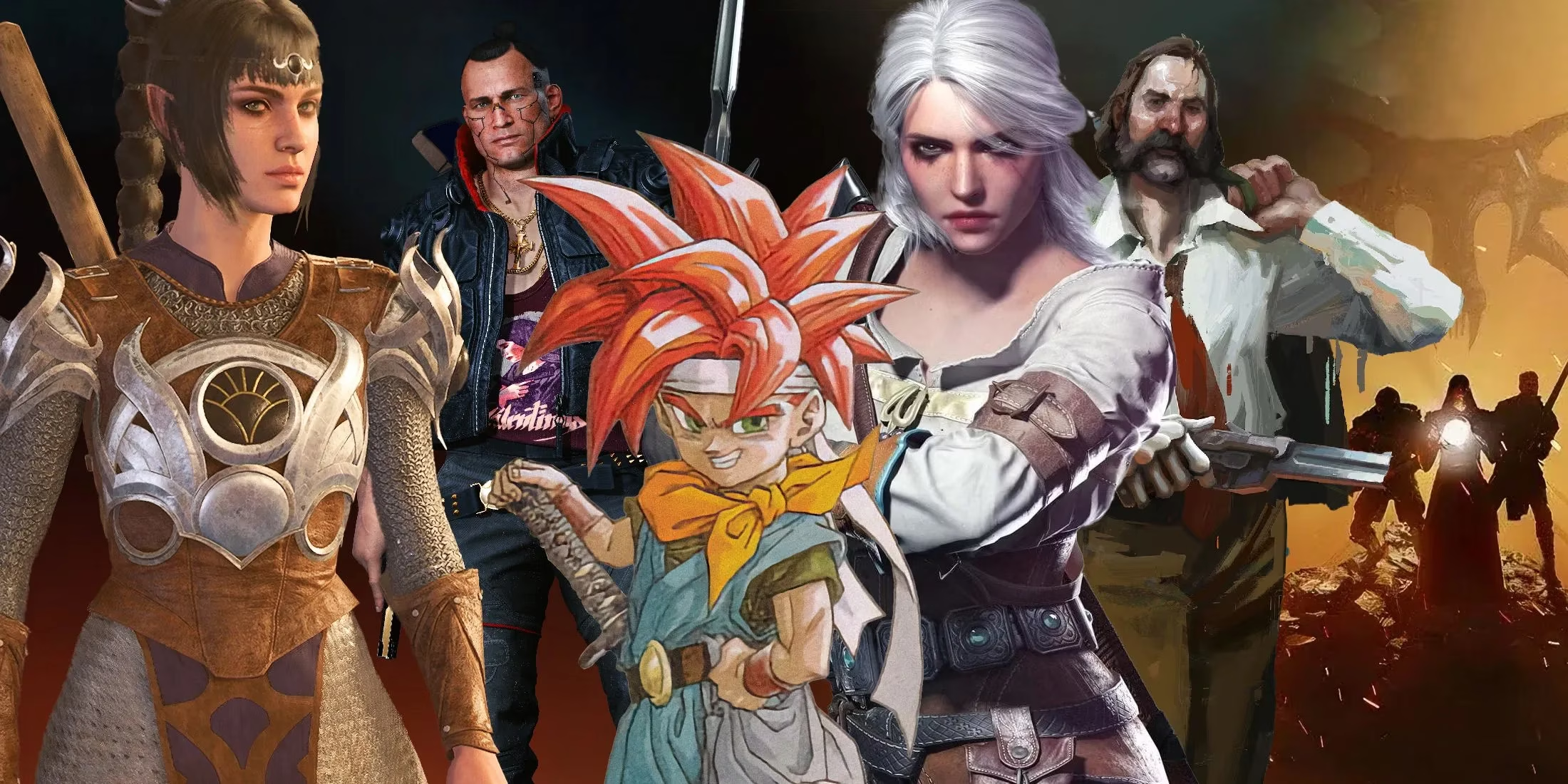
Man, let me tell you something, fellow gamers. There's nothing quite like that feeling when you're waist-deep in an RPG, and instead of the magic wearing off, it just keeps pulling you in deeper. You know the ones—the games where ten hours in, you realize you've only just scratched the surface, and you're already planning your next session before you've even turned it off. That's the real deal. A killer progression curve isn't just nice to have; it's the lifeblood of the genre. An RPG that shows all its cards in the first act? Total snooze fest. But the ones that master the slow burn, that keep revealing new layers, new wonders, new challenges? Those are the games that live in your head rent-free for years. I've spent countless hours in these worlds, and I'm here to break down why some titles are simply built different, getting more immersive and rewarding with every quest completed.
Gothic: The OG Brutal Grind That Pays Off
Okay, real talk. If you started playing Gothic back in the day, you probably threw your mouse/keyboard/controller at least once. The beginning is, quite frankly, brutal. You're weaker than a newborn scavenger, and your only move is to clumsily lure them out one by one and hope for the best. It's like the game is actively messing with you. But here's the thing, the progression. Oh, the sweet, sweet progression. Once you manage to join a camp and start learning from the trainers—using your hard-won XP—everything changes. That moment when you go from running from a pack of wolf-like creatures to confidently taking them down? Chef's kiss. It's a masterclass in making you earn your power. It’s not just getting a bigger number; it's the shift from prey to predator that feels intensely, addictively rewarding. This game doesn't hold your hand; it slaps it away and tells you to get good, and man, does it feel amazing when you finally do.
The Witcher 3: How to Master the Art of the Slow Reveal
CD Projekt Red are absolute wizards when it comes to pacing. The Witcher 3 kicks off in White Orchard, which is basically a gorgeous, bite-sized tutorial zone. It's cozy, it teaches you the ropes—Geralt's signs, potions, the detective-style Witcher Senses—and it doesn't overwhelm you. But it's all a setup. By the time you wrap up there, you've met Yennefer, learned about Ciri and the Wild Hunt, and the stakes get cranked to eleven. You head to Velen, and boom, you're hit with this massive, haunting region full of stories. And just when you think you've seen it all, Skellige, Novigrad, Toussaint... the Continent just keeps unfolding. The game keeps its cards so close to its chest at the start, and then deals you a royal flush over a hundred hours. It’s storytelling genius.
Disco Elysium: An Amnesiac Detective and a World That Unfolds in Your Mind
This game, folks. This game is a trip. It starts with a literal and figurative bang: you wake up as a detective with a world-class hangover and zero memory, not even your own name. The entire first act is just you, in your underwear, trying to piece together who you are in a single hotel room. Before you even see the city of Revachol, the game's unique voice—equal parts philosophical, hilarious, and tragic—is crystal clear. But the real hook? The worldbuilding. As you stumble out and meet your (incredibly patient) partner Kim Kitsuragi, the city slowly reveals itself. It's not about unlocking new combat skills; it's about unlocking new ideas, political factions, and layers of history. The more you talk, the more you think, the more engrossed you become. It's a game that gets better because your understanding of it deepens.
Cyberpunk 2077: The Phoenix That Rose from the Bugs
Yeah, we all remember the launch. It was... rough. But fast forward to today, post-Edgerunners, post-updates, and this game is a straight-up vibe. It takes its sweet time getting to the main event, too. The whole Arasaka heist? That's not the prologue; that's the catalyst. The real story starts after, when V is literally fighting for control of their own body and mind against Johnny Silverhand's engram. That's when Night City stops being a pretty backdrop and becomes a character—a massive, neon-drenched, deadly urban sprawl you're hopelessly tangled in. The sense of urgency, the factions, the sheer scale of verticality... it’s a slow-burn into pure, unadulterated immersion. They really turned it around.
Chrono Trigger: The Timeless Gift (Pun Intended)
If there's a textbook definition of a game that "keeps on giving," it's Chrono Trigger. It ropes you in with that gorgeous Akira Toriyama art and comforting JRPG mechanics. Then it introduces time travel, and your mind explodes with possibilities. But the real game-changer? Getting the Epoch. This isn't just a fast-travel device; it's a key to the multiverse. You can literally tackle the final boss, Lavos, at multiple points in the story, leading to a bunch of wildly different endings. The game opens up from a linear adventure into a sandbox of temporal cause-and-effect. It rewards curiosity and replayability like few games before or since. Talk about value for your gil!
Fallout: New Vegas: The Journey IS the Destination
Obsidian's masterpiece understands one thing perfectly: anticipation. The early game is all about the struggle to reach the glittering titular city, New Vegas. You're funneled through the Mojave Wasteland, learning its harsh rules, meeting its quirky inhabitants. Reaching the Strip feels like a monumental achievement. But plot twist: that's just the end of the tutorial. Now the real political chess game begins. Will you side with Mr. House, the NCR, Caesar's Legion, or go it alone? Every faction, every side quest, weaves into this rich tapestry of consequence. The game never lets up, constantly presenting you with morally grey choices that keep you on the edge of your seat. The first act is a slow build to one of the most player-driven RPG adventures ever made.
Final Fantasy VI: When the Villain Actually Wins
Most JRPGs follow a formula: hero's journey, defeat the big bad, save the world. FFVI said, "Hold my Ether." The World of Balance plays it relatively straight—you're fighting the Empire, gathering allies, it's epic but familiar. Then the Floating Continent happens. Kefka, the clown, doesn't just threaten the world; he succeeds. He destroys it. The world map changes. The party is shattered. You're left controlling Celes on a deserted island, and the game transforms. It becomes a non-linear, melancholic search for your lost friends in a post-apocalyptic version of the world you just spent 20 hours saving. The shift in tone, structure, and scope is breathtaking even by today's standards. The second half of the game is why it's a legend.
Baldur's Gate 3: A Masterclass in Three-Act Structure
Larian Studios didn't just make a game; they crafted an experience that scales up with every chapter. Act 1 on the Sword Coast is already incredibly rich—mind flayers, tadpoles, groves under siege. You think, "Wow, this is huge." Then you hit Act 2 and the Shadow-Cursed Lands. The atmosphere thickens, the stakes get personal, and you meet Ketheric Thorm, voiced with terrifying gravitas by J.K. Simmons. This act is so densely packed, so narratively tight and menacing, that it sets an absurdly high bar. By the time you reach the sprawling, dense city of Baldur's Gate in Act 3, some folks actually felt it was a step down—not because it's bad, but because Act 2 was just that good. That's the sign of a game that grows, evolves, and refuses to plateau.
So, what's the common thread here? These are games that understand investment. They don't blow their load in the first five hours. They build worlds with depth, systems with complexity, and stories with layers that only reveal themselves with time. They trust the player to stick around for the payoff, and boy, do they deliver. In an age of instant gratification, these RPGs are a reminder that the most rewarding adventures are often the ones you have to sink your teeth into. They're the gifts that keep on giving, long after the credits might have rolled in a lesser game. Now if you'll excuse me, I think it's time for another replay... decisions, decisions!