Bhaal's Cruel Punishment: The Most Disturbing Ending in Baldur's Gate 3
Explore the darkest Baldur's Gate 3 endings with the Dark Urge, where Bhaal's legacy leads to a uniquely harrowing and unforgettable fate.
I have walked the darkest paths Faerûn has to offer, embracing the bloody legacy of my sire, Bhaal. Yet, even in my most depraved moments, I never imagined a fate as exquisitely cruel as the one that awaits those who dare defy the God of Murder at the very last moment. This isn't just an evil ending; it's a personal damnation, a masterpiece of torment that makes the other dark conclusions look like child's play. Let me tell you, it's a real mindf**k, a narrative gut-punch that lingers long after the credits roll.
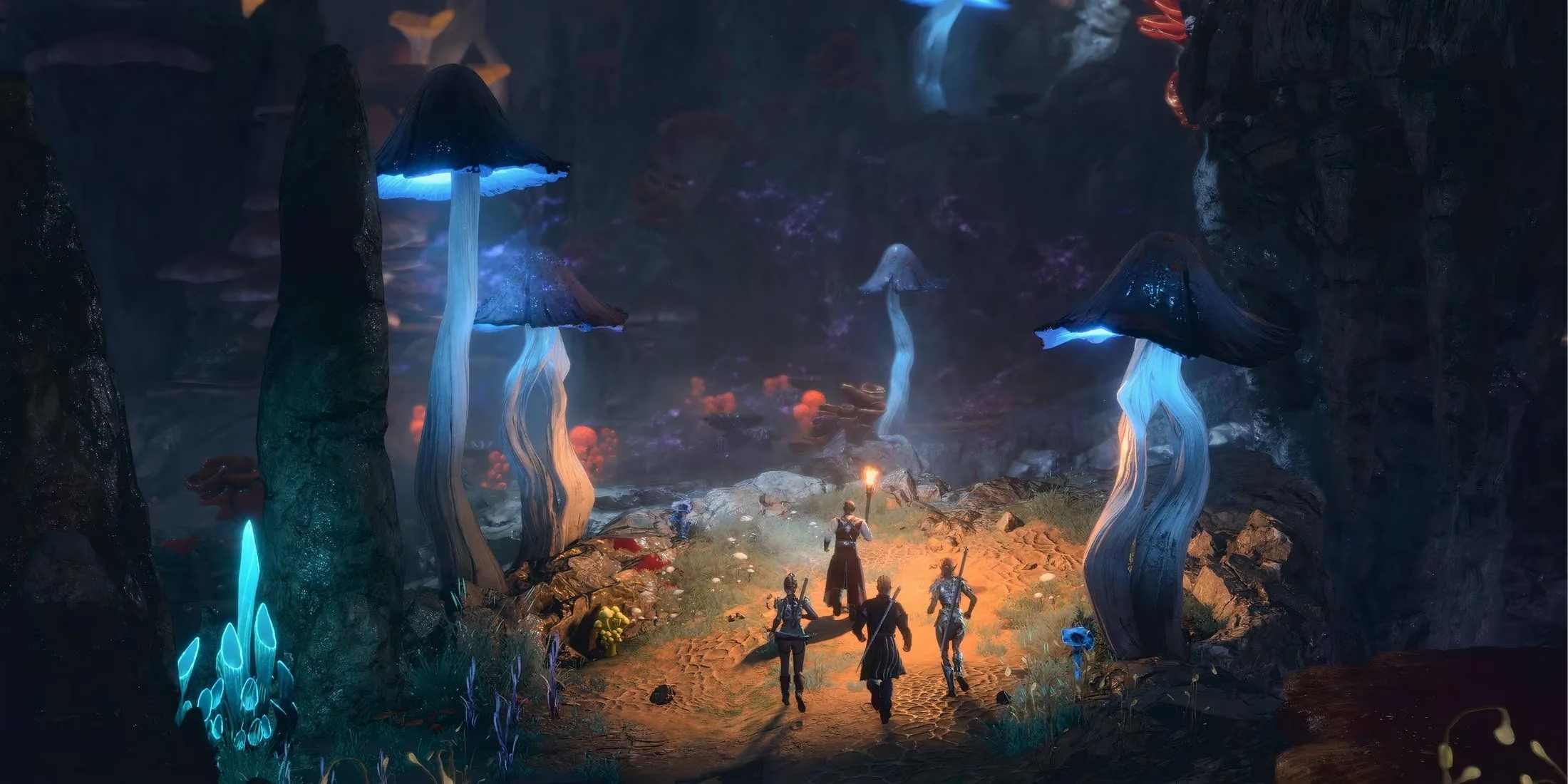
The journey to this nadir requires a commitment to absolute depravity. You must become the monster fully. I remember the scent of Selûnite blood as I ended Isobel's light, plunging the Last Light Inn into eternal shadow. I felt the grotesque power of the Slayer form coursing through me. I knelt before Bhaal in Act 3, my father, and accepted his vile blessing. This path is one of profound loss. Companions of light—Jaheira, Minsc, the noble Wyll, the fiery Karlach—are cast aside or destroyed. Even Gale's potential is snuffed out early. You stand alone, a perfect instrument of murder. It's a lonely road, but hey, no one said becoming a legend was easy.
All roads lead to the final confrontation with the Elder Brain. The obvious choices for a loyal Bhaalist are clear:
-
Remain Loyal: Claim the Absolute for Bhaal.
-
Embrace Control: Dominate the Elder Brain and end all life.
But there's a third path, a spark of rebellion in a soul drowned in blood. You can betray your god. In that pivotal moment, you can order the Absolute to destroy all tadpoles and itself. On paper, this sounds like a redemption, a last-second turn to the light. Oh, how naive that thought is. In Bhaal's cosmos, there is no redemption—only punishment.
This "good" act triggers the sub-quest Destroy the Elder Brain, but for the Dark Urge, the outcome is uniquely horrific. Bhaal's influence is not a cloak you can simply shed; it is your blood, your essence. The betrayal enrages him, and his retribution is not annihilation, but something far more creative and sadistic.
In the aftermath, you are presented with three pathetic, futile choices:
-
Immediate Suicide 😔: Ironically, the best outcome. A clean end.
-
Submit to Imprisonment 🔒: For the safety of others, you ask to be locked away.
-
Try to Resist 💪: Fight the urges with sheer willpower.
Here's the kicker: options 2 and 3 lead to the exact same, devastating conclusion. Resistance is futile. The prison cannot hold you.
What follows is a six-month descent into a hell that is deeply, intimately yours. The game's Narrator, that ever-present voice in my head, lays bare the agony in a haunting epilogue scene. You watch your old companions celebrating from the shadows, a ghost haunting your own life. And what a half-year it has been...
| The Torment | The Description |
|---|---|
| Loss of Autonomy | Trapped in your own body, forced to mindlessly worship Bhaal. |
| Violence & Violation | Sexual assault committed while you are a passenger in your own flesh. |
| Random Slaughter | Killing innocents, driven by an insatiable, feral hunger. |
| Self-Devouring | The ultimate taboo—eating parts of your own body. |
| Complete Breakdown | Self-harm and loss of basic bodily functions. |
The scene is visceral. You don't just hear about it; you experience the fragmented, horrific memories. The intimacy of this torture is what sets it apart. Other evil endings are about grand, world-shattering power. This one is about the systematic destruction of a self. It's personal, baby, in the worst way possible.
The epilogue doesn't end with reflection or quiet despair. It ends with a chilling finality. Your character, now little more than a rabid beast wearing a familiar face, stumbles toward the campfire light of your former friends. The intention is clear: one last, bloody reunion. The screen fades to black on that horrifying implication. Talk about leaving a player with some serious baggage.
While dark fantasy has its place, and this ending is undeniably consistent with Bhaal's lore—he is, after all, the God of Murder, not mercy—this conclusion is in a league of its own in terms of sheer disturbing content. For players who have spent dozens of hours role-playing this character, the emotional whiplash and profound violation of the protagonist can be genuinely distressing. It's a brilliant piece of storytelling, but it's also a giant, flashing content warning. If you're sensitive to themes of sexual violence, profound self-harm, and complete psychological annihilation, you might want to give this one a hard pass. The other endings? They're dark. This one? This one is a descent into a special kind of madness that even I, a spawn of Bhaal, find haunting. It's the ultimate cautionary tale: in the world of Baldur's Gate 3, sometimes trying to be a hero at the last second earns you a fate worse than any villain's.