Baldur's Gate 4 Should Embrace the City, Learning from Cyberpunk 2077's Night City Mastery
Baldur's Gate 4 and Cyberpunk 2077 inspire a bold vision: an immersive RPG set entirely within the vibrant city of Baldur's Gate.
As a veteran gamer who has spent countless hours navigating the Sword Coast, I find myself reflecting on the curious relationship between the Baldur's Gate series and its namesake city. From my experience, the city of Baldur's Gate, the beating heart of the Forgotten Realms, has always felt more like a grand finale destination than a true home. In the monumental Baldur's Gate 3, we only truly stepped into its sprawling, chaotic streets in Act 3. It was glorious, dense, and alive, but it left me wanting more—an entire adventure woven into its very cobblestones. Now, in 2026, as speculation about Baldur's Gate 4 begins to simmer, I believe the key to its success lies not in another continent-spanning epic, but in a radical, focused ambition: setting the entire game within the city limits, using CD Projekt Red's Cyberpunk 2077 as the ultimate blueprint.
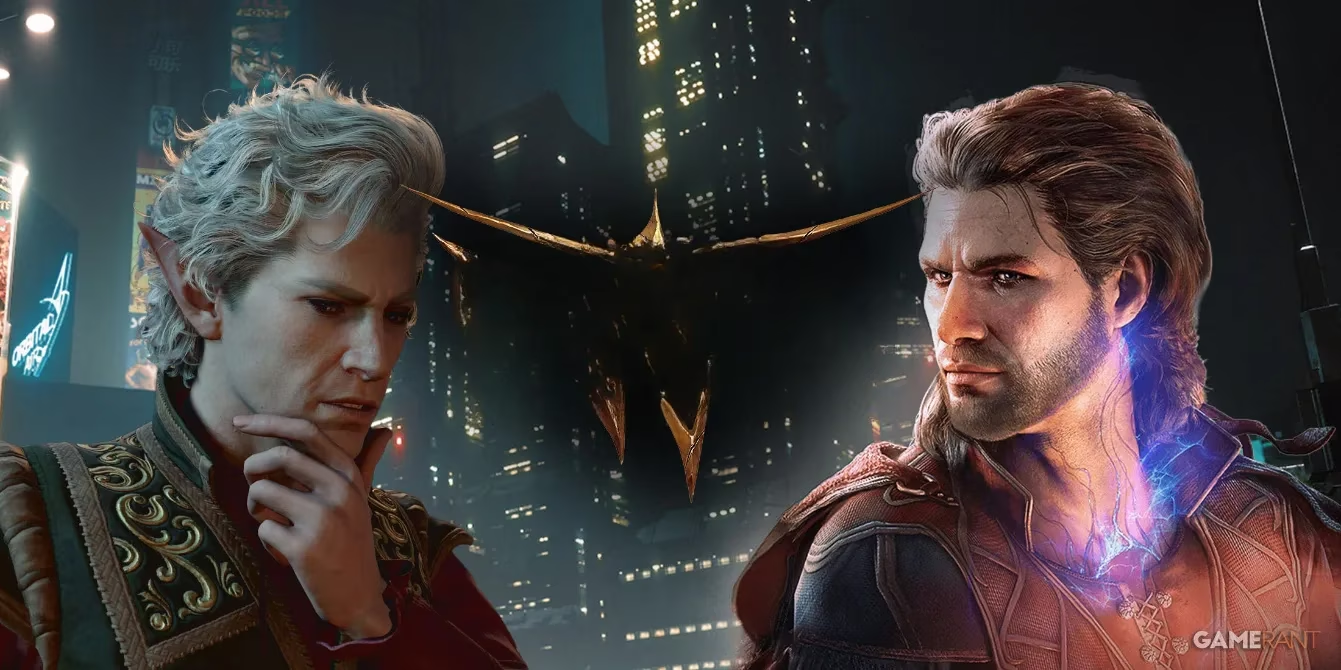
The technical and design challenge of building a single, fully-realized city that can sustain a 100+ hour RPG is immense. History is littered with games that had to compromise. We saw it in Dragon Age 2's repetitive Kirkwall, segmented by loading screens. We saw it in the scaled-down, sometimes-static cities of Oblivion. These titles mitigated the load by limiting scope, gating districts, or filling streets with non-interactive crowds. But Cyberpunk 2077's Night City proved this paradigm is outdated. It delivered a seamless, vertical megalopolis teeming with life, from the glittering towers of Corpo Plaza to the grimy decay of Pacifica. It wasn't just a backdrop; it was the protagonist. For Baldur's Gate 4 to follow in BG3's footsteps as a genre-defining title, it must embrace this modern, uncompromising vision of an urban setting.
Why would this work for Baldur's Gate? The city itself is a character of profound depth and contradiction. Baldur's Gate 3 gave us tantalizing glimpses:
-
The Refugee Crisis outside the walls in Rivington, highlighting social strife.
-
The opulent and deadly patriar estates of the Upper City (which was sadly cut content).
-
The labyrinthine, monster-infested sewers beneath the streets.
-
The bustling, chaotic markets and specialized shops of the Lower City.
Yet, this only scratches the surface. A game entirely within the city could explore so much more, creating a density of experience that a broader game cannot match. Imagine:
-
Political Intrigue: Navigating the Council of Four's machinations from inside the city hall.
-
Guild Wars: Getting caught in a violent conflict between the Guilds, like the Iron Throne or the Shadow Thieves.
-
Vertical Exploration: Not just sprawling outward, but upward into skyscrapers and downward into ancient, buried ruins beneath the foundation.
-
Dynamic Districts: Areas that change based on your actions—a cleaned-up sewer district, a merchant quarter you helped thrive, a neighborhood fallen to cult influence.
Crucially, this focus would give Baldur's Gate 4 a distinct identity separate from its predecessor. Baldur's Gate 3 is a masterpiece of journey and discovery across diverse landscapes. Its successor could be a masterpiece of depth and immersion in a single, incredibly detailed locale. It would shift the fantasy from epic pilgrimage to intense urban survival and power struggle.
From a technical perspective, the tools and lessons are now available. Cyberpunk 2077's post-launch renaissance, especially with its 2.0 update and Phantom Liberty expansion, showed how to build a believable, system-driven city. Modern engines and hardware can handle dense NPC schedules, complex AI routines for city life, and vast, seamless environments without the load-screen barriers of the past. The challenge is not if it can be done, but how well it can be executed with the rich lore of the Forgotten Realms.
In my view, the potential is staggering. A fully realized Baldur's Gate would offer:
| Aspect | Potential in BG4 |
|---|---|
| Scale | A true 1:1 feeling of a metropolis, from docks to outer walls. |
| Diversity | Extreme contrasts between opulent Upper City and desperate Outer City slums. |
| Interactivity | Every shop, tavern, and alleyway could house quests, secrets, and characters. |
| Player Impact | Your actions could visibly and permanently alter the city's districts and politics. |
This approach aligns perfectly with the core fantasy of Dungeons & Dragons: adventure can be found anywhere, especially in the heart of a city where a thousand stories intersect. We wouldn't be losing scope; we'd be trading horizontal breadth for vertical depth. The wilderness adventure is replaced by the urban jungle, where the dragons wear fine silks and the dungeons are guild basements and haunted mansions.
Ultimately, Baldur's Gate the franchise owes it to Baldur's Gate the city. After serving as the iconic namesake and final destination for so long, it deserves to be the sole star of the show. Cyberpunk 2077 laid out the technical and design roadmap for a living, breathing city-RPG. By learning from its successes (and its initial stumbles), Baldur's Gate 4 could achieve something truly legendary: giving us not just a game set in a city, but a game that is the city. As a player, that's a journey into the depths of urban fantasy I am ready to take. The Sword Coast will always be there, but for one game, let us get gloriously, completely lost in the streets of Baldur's Gate.