A Persistent Flaw in a Masterpiece: Isobel's Self-Destructive AI in Baldur's Gate 3
In a stunning send-off with the final Patch 8, the 2026 classic Baldur's Gate 3 remains a masterpiece, yet a baffling AI flaw in the pivotal Last Light Inn defense threatens to tarnish its brilliant legacy.
Even now in 2026, years after its monumental final patch, Baldur's Gate 3 stands as a titan of the RPG genre, a game whose shadow stretches long over the industry. Having spent countless hours in Faerûn, I can attest that Larian Studios' creation is a masterpiece worthy of every Game of the Year accolade it received. The final Patch 8 was a magnificent send-off, adding 12 new subclasses that opened character builds like a master locksmith opening a complex safe. Yet, despite these years of polish and expansion, one glaring, long-standing issue persists like a stubborn stain on otherwise immaculate armor, and it threatens to forever tarnish a specific, pivotal moment in the game: the chaotic defense of Isobel at the Last Light Inn.
This encounter is infamous among the community. The premise—a sudden ambush by Marcus and his Winged Horrors during what seems like a peaceful conversation—isn't the core problem. In fact, I agree that the unexpected nature of the fight is a brilliant, tabletop-inspired surprise, a narrative curveball that keeps you on your toes. The true antagonist of this scene isn't Marcus; it's Isobel's own artificial intelligence. Her programming operates with the self-preservation instincts of a moth relentlessly drawn to a flame, transforming a challenging tactical skirmish into a maddening exercise in babysitting a character who seems determined to die.
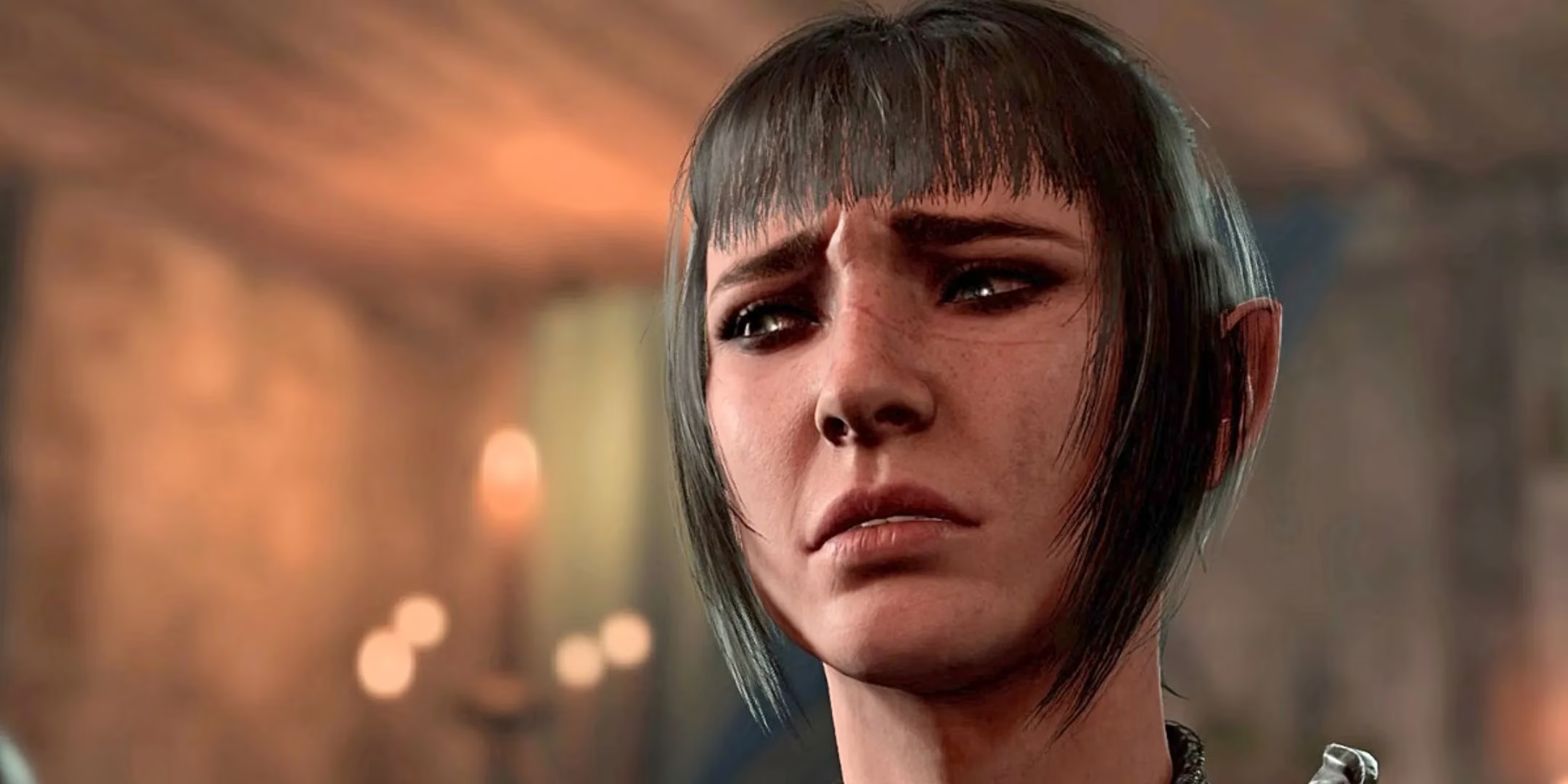
The fight's structure creates a profound dissonance. Marcus's goal is explicit: abduct Isobel. Logically, Isobel—a seasoned Cleric who understands her vital role in maintaining the protective dome over the Last Light Inn—should be prioritizing her own survival above all else. Yet, her AI behaves with the reckless abandon of a lemming marching toward a cliff. The community's frustration, perfectly highlighted in posts from players like ByzantineBasileus, centers on this irrational behavior. You, the player, deploy every protective measure in your arsenal:
-
Casting Sanctuary on her to make her untargetable.
-
Making her Invisible to remove her from the fray.
-
Positioning your party as a living shield.
And what does Isobel do? She immediately breaks these spells by taking a hostile action, often by charging directly into a cluster of Winged Horrors. This isn't just a minor tactical error; it's a complete narrative and mechanical breakdown. It feels less like a fair fight and more like you're trying to stop a runaway wagon with your bare hands while the person inside is actively sawing at the reins.
This leads to the most disheartening feeling: that Larian may have secretly intended for her abduction to be the "default" outcome. The fight almost presents a false binary choice—a common illusion in game design—where player agency feels undermined by a companion's suicidal AI. If she is meant to be taken, why make it a fight at all? A cutscene would have been a cleaner, if less interactive, solution. By presenting it as a winnable battle, the developers set an expectation of fairness that Isobel's behavior violently shatters. Her actions are as contradictory as a firefighter sprinting into a burning building only to start dousing the walls with gasoline.
So, how could this be improved, even in a post-final-patch world where hope for official fixes is slim? The solution lies not in making the fight easier, but in making Isobel smarter. Her AI needs a fundamental rewrite to incorporate basic self-preservation. This wouldn't make her an invincible asset, but a rational ally. Key improvements would include:
-
Spell Awareness: Isobel should recognize and maintain beneficial spells cast upon her by allies. A Sanctuary spell should make her hunker down, not cancel it to throw a negligible attack.
-
Positional Logic: As the primary target, she should prioritize staying near the center of your defensive formation, not sprinting to the front lines. Her movement should be calculated, not chaotic.
-
Balanced Adversary: To compensate for a smarter Isobel, Marcus could be given tools like See Invisibility in his spell list. This maintains the challenge but shifts it from "fighting your own ally's AI" to "outsmarting a powerful foe."
Lore-wise, this is the only change that makes sense. Isobel is not a novice; she is a trained cleric with the weight of countless lives on her shoulders. Her current behavior is a character assassination by poor programming. The consequences of her failure are dire—the fall of the Last Light Inn and the death of all within—which makes her kamikaze tactics even more baffling.
In the end, this single fight stands as a strange testament to Baldur's Gate 3's journey. It's a game of breathtaking scope and quality, yet it houses this one persistent bugbear, a rogue element that operates with all the jarring inconsistency of a beautifully composed symphony that has one violinist relentlessly playing off-key. While Patch 8 added wonderful new layers to the game, it left this core AI issue untouched. As a player who cherishes this world, it's my lingering regret that this brilliant, award-winning masterpiece carries this one avoidable flaw in its otherwise stellar coding, a reminder that even the most perfect realms can have their cracks in the foundation.