A New Dawn for D&D Gaming: Why Giant Skull's Action Adventure Might Be The Perfect Follow-Up to Baldur's Gate 3
Wizards of the Coast's new Dungeons & Dragons single-player action adventure from Giant Skull studio boldly reinvents the Forgotten Realms legacy.
As I eagerly scanned the horizon of fantasy gaming news, the announcement from Wizards of the Coast about a new Dungeons & Dragons project felt like spotting a fresh, uncharted island after sailing the well-traveled seas. The fact that this adventure, emerging from the newly-founded Giant Skull studio, promises to be nothing like the monolithic Baldur's Gate 3 wasn't a letdown—it was a profound relief. Having spent countless hours in the rich, turn-based world Larian Studios crafted, a part of me yearned for more of that exact formula. Yet, the prospect of the same team or another attempting a direct sequel seemed as daunting and potentially misguided as asking a masterful classical composer to write a pop album sequel to their symphony. It's a different craft, with a different audience and different rules. The confirmation that this is an "all-new, single-player action adventure title" set in the Forgotten Realms signals not a retreat, but a bold expansion of what a D&D game can be in this modern era.
Escaping the Immense Shadow
Make no mistake, the shadow cast by Baldur's Gate 3 is long and deep, a titan among the gaming landscape of the 2020s. For any studio, stepping into those shoes would have been a Herculean task fraught with peril. I believe the decision to avoid a direct follow-up is a stroke of strategic genius. Imagine if a newer, less-established studio than Larian had been tasked with Baldur's Gate 4. The dynamic would have been less like a natural succession and more like a talented local theatre troupe being handed the reins to a billion-dollar Hollywood franchise's next installment overnight. The pressure to replicate creative magic, meet astronomical expectations, and operate within an inherited framework would have been stifling, likely leading to a product forever viewed as a lesser imitation.
-
Creative Freedom vs. Franchise Legacy: Larian earned its creative freedom through the critical and commercial success of the Divinity: Original Sin series. A new team would have started with far less leverage, potentially forced to adhere to a rigid blueprint.
-
The Comparison Trap: Any game bearing the Baldur's Gate name would be compared, pixel-for-pixel and choice-for-choice, with its predecessor. This is an almost impossible standard, given BG3's status as one of the highest-rated games of the last decade.
-
A Different Kind of Adventure: By carving a new path, Giant Skull's game isn't just avoiding comparison; it's offering a fundamentally different experience. This is crucial for the health of the D&D gaming ecosystem.
Charting Uncharted Territory for the Franchise
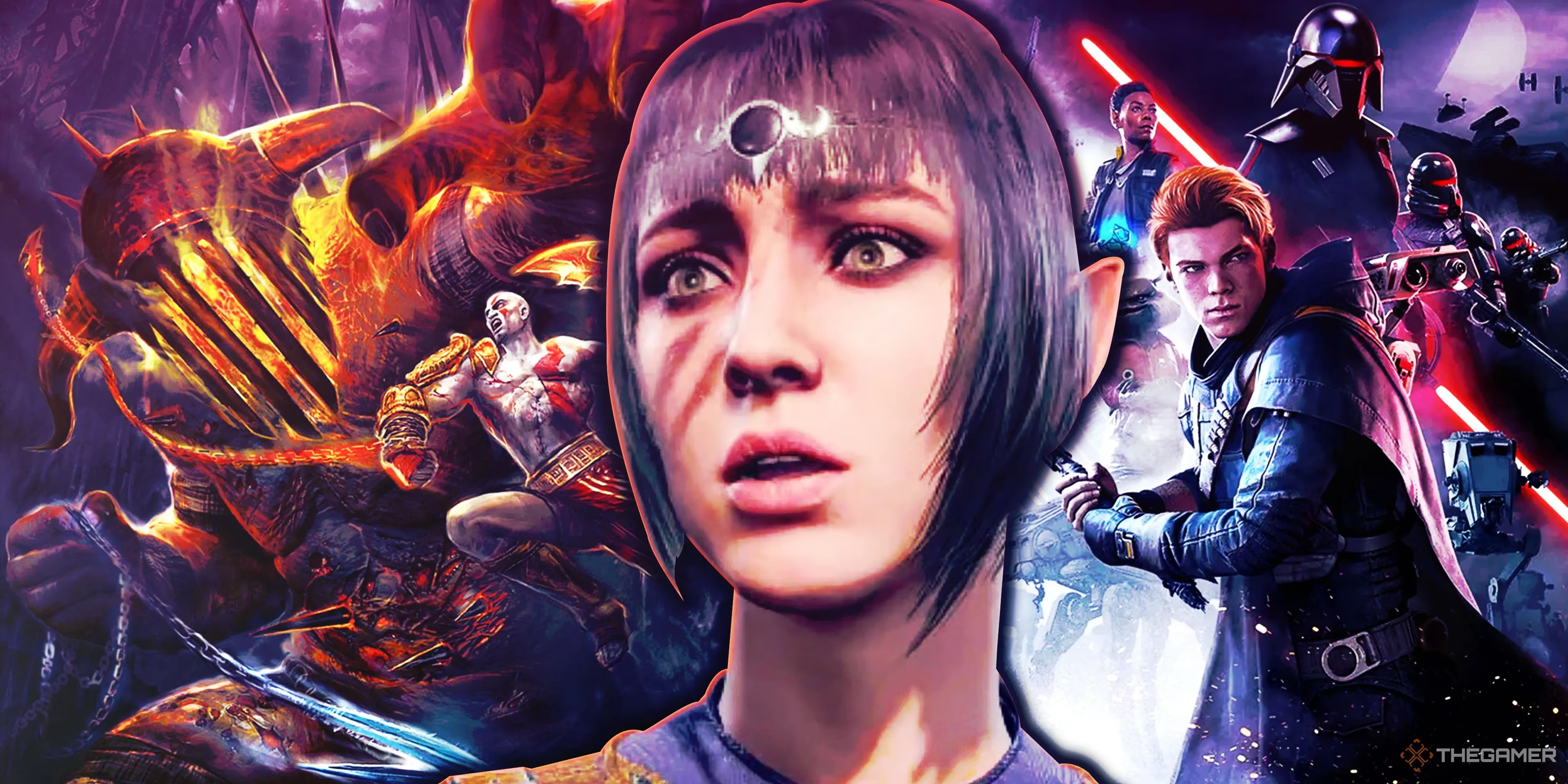
The shift from isometric, party-based RPG to third-person action-adventure is not a minor tweak; it's a tectonic shift for digital D&D. Historically, D&D video games have been synonymous with a specific style of computer role-playing game (CRPG), a legacy stretching back to the late '90s. This new direction, led by veteran director Stig Asmussen (of God of War 3 and Star Wars Jedi fame), is venturing into realms the franchise has rarely, if ever, explored in a major AAA release. It's as if we've been marveling at intricate, beautiful oil paintings of the Forgotten Realms for years, and now someone is offering us a chance to step directly into a dynamic, immersive sculpture of that same world. The perspective changes everything.
This bold move is only possible because of Baldur's Gate 3's monumental success. Larian's masterpiece didn't just satisfy fans; it rejuvenated the entire brand and built up enormous goodwill. It acted as a stabilizing force, allowing Wizards of the Coast the confidence to experiment. If this action-adventure title had been announced while the classic RPG side of D&D lay fallow, the fan reaction might have been one of frustration, feeling a core identity was being abandoned. Now, it can be seen as an exciting expansion.
| Era | Typical D&D Game Style | New Giant Skull Game |
|---|---|---|
| 1990s-2000s | Isometric, Real-Time-with-Pause/Turn-Based CRPG | ❌ Not This |
| 2010s | Mixed (MMOs, Strategy, Older CRPGs) | ❌ Not This |
| 2020s (Post-BG3) | AAA Narrative-Driven Action-Adventure | ✅ This! |
Navigating Potential Kraken in the Water
Of course, this new course is not without its dangers. The primary risk is one of mismatched expectations. If players approach this game anticipating the deep, systemic role-playing, elaborate character builds, and sprawling party management of Baldur's Gate 3, they may be disappointed by a more linear, narratively-focused action experience. We saw a similar dynamic play out recently with Dragon Age: The Veilguard, which struggled under the weight of its franchise's RPG legacy when it pivoted towards a more action-oriented style. The D&D name carries its own weight and history.
However, I'm optimistic this can be mitigated. This is where transparent marketing and early previews are absolutely vital. The studio and publisher must be clear from the outset:
-
This is not Baldur's Gate 4. It's a new story, a new genre, a new experience.
-
Show, don't just tell. Gameplay reveals need to showcase the visceral, moment-to-moment action, the exploration, and the personal, intimate scale of the adventure.
-
Embrace the new identity. The game must confidently stand on its own two feet, making a compelling case for why this is the D&D experience players want right now.
The Bigger Picture: Room for All Adventurers
There's a broader conversation in the RPG genre about depth versus accessibility. Recent breakouts like Kingdom Come: Deliverance 2 and Clair Obscur: Expedition 33, both in 2026, prove there's a massive, dedicated audience for complex, "crunchy" RPG systems. Yet, the gaming world is vast, and there is room for masterful execution in different formats. A well-crafted, story-driven action-adventure set in the D&D universe could be the perfect gateway for a new generation of fans, much like the Jedi games introduced many to the Star Wars lore. It could be the thrilling, cinematic blockbuster to complement the deep, strategic drama of the CRPG.
For Giant Skull, this different direction is their greatest strength. It gives their game the space to breathe, to be judged on whether it's a great action-adventure game first and foremost, rather than a poor imitation of a legendary RPG. I don't know if their game will capture the magic of a critical hit. But I do know this: by choosing to build their own tavern in a new part of the city, rather than trying to renovate the most famous inn in the land, they've given themselves a real chance to create something memorable, unique, and ultimately, truly successful on its own terms. And as a fan of both deep RPGs and thrilling adventures, that's an expedition I'm incredibly eager to embark on.